By Survival Boys Editorial Team
When people imagine survival situations, they often focus on physical challenges.
They picture building shelters, starting fires, finding food, crossing rough terrain, or surviving harsh weather deep in the wilderness. While those skills are important, experienced survival instructors and emergency responders consistently point to another factor that determines success even more often:
The human mind.

Mental resilience influences every survival decision a person makes. Fear, stress, panic, exhaustion, isolation, and uncertainty can break down judgment long before the body physically fails. In many emergencies, the greatest battle happens internally rather than externally.
The psychology of survival is what separates people who adapt from those who collapse under pressure.
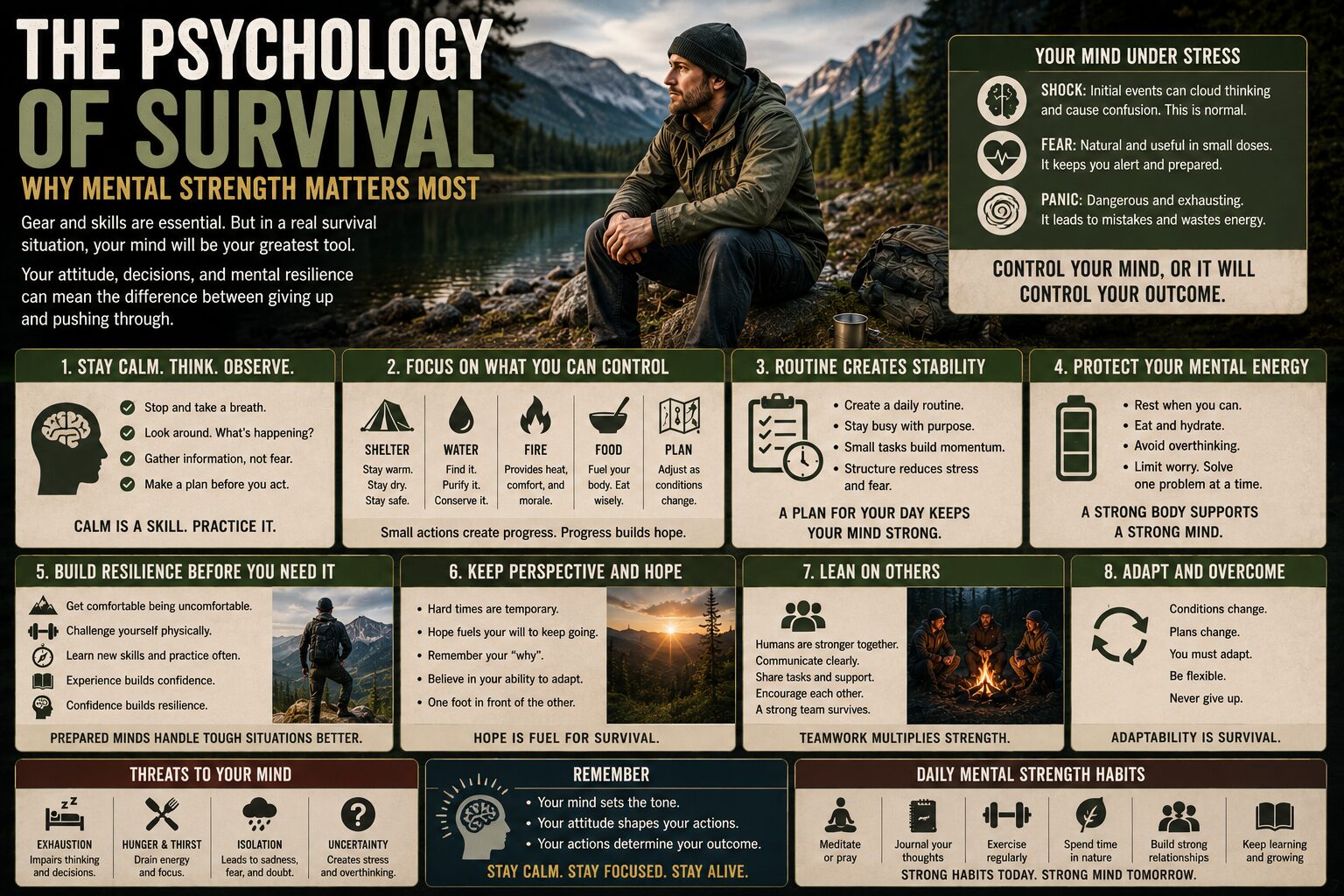
One of the first psychological reactions people experience during emergencies is shock. Disasters, accidents, severe weather, or getting lost often happen suddenly, leaving the brain struggling to process reality. During shock, people may freeze, become confused, or fail to act even when obvious dangers exist.
This reaction is completely normal.
The human brain is designed to respond rapidly to danger, but extreme stress can overload decision-making processes temporarily. Adrenaline surges through the body, heart rate increases, and perception narrows sharply. This is why people sometimes make irrational decisions during emergencies despite being intelligent and capable under normal conditions.
The problem is not fear itself.
Fear is natural and often useful because it increases awareness and prepares the body for action. The real danger comes when fear transforms into panic. Panic destroys clear thinking, causes rushed decisions, wastes energy, and spreads confusion quickly through groups.
Survival experts often emphasize the importance of slowing down mentally before taking action. People who pause, breathe, observe their surroundings, and think carefully usually perform far better than those reacting emotionally.
This principle becomes especially important in wilderness survival situations. A lost hiker who immediately starts running through unfamiliar terrain may become more disoriented and exhausted. Someone who stops calmly and evaluates the situation often finds solutions much faster.
The human brain craves certainty, and survival situations remove certainty almost completely. People do not know how long the emergency will last, whether help is coming, or how conditions may change next. Uncertainty creates enormous psychological pressure over time.
This is one reason routines become so important during survival situations.
Simple tasks provide structure and stability when everything else feels chaotic. Building a fire, organizing supplies, collecting water, preparing food, or maintaining shelter all create a sense of control. Even small accomplishments improve morale because they remind people they still have influence over their situation.
Morale is one of the most underestimated survival tools in existence.
A person who loses hope often stops making effective decisions entirely. History is filled with survival stories where determination and mental endurance mattered more than physical strength alone. People who continue believing survival is possible usually keep searching for solutions, conserving energy, and adapting to changing conditions.
Those who mentally surrender often decline rapidly.
This does not mean survival is simply about positive thinking. Optimism alone cannot replace food, water, shelter, or medical care. However, mindset directly affects behavior, and behavior affects survival outcomes.
Mental resilience allows people to use resources more effectively under pressure.
Isolation creates another major psychological challenge during emergencies. Humans are social creatures by nature. Extended loneliness can damage emotional stability, increase fear, and reduce motivation quickly. Wilderness survival stories often reveal how dangerous isolation becomes after prolonged periods alone.
This is one reason communication matters so much during disasters. Radios, community support, family contact, and teamwork all strengthen psychological endurance significantly.
Group survival introduces its own mental dynamics as well. Fear spreads rapidly through groups when leadership disappears or communication breaks down. Calm individuals often stabilize others simply through controlled behavior and clear decision-making.
Strong leadership in emergencies is usually quiet and practical rather than dramatic. People respond best to leaders who stay focused, provide direction, and maintain emotional control under stress.
Preparation itself has enormous psychological value.
People who prepare ahead of time often remain calmer during emergencies because uncertainty decreases dramatically. Stored food, emergency plans, medical supplies, backup power, and practiced survival skills all create confidence before disasters happen.
Preparedness reduces helplessness.
This is why experienced survivalists practice skills repeatedly instead of only collecting gear. Familiarity creates confidence. Someone who has built fires in storms before, purified water multiple ways, or navigated difficult terrain previously will usually remain calmer during real emergencies.
Training changes how the brain reacts under pressure.
Military survival programs, wilderness training schools, and emergency response organizations all understand this principle. Repetition builds automatic responses that function even during high stress.
The body and mind also affect one another directly during survival situations. Hunger, dehydration, sleep deprivation, and exhaustion all reduce mental performance significantly. Decision-making becomes weaker as physical condition deteriorates.
This creates dangerous cycles.
A tired person makes mistakes that worsen survival conditions, leading to even greater exhaustion and stress. Maintaining hydration, rest, warmth, and nutrition therefore protects mental clarity as much as physical health.
One fascinating aspect of survival psychology is how perception changes under stress. Time may feel distorted. Sounds become exaggerated. Small problems begin feeling overwhelming. Darkness, bad weather, and unfamiliar environments intensify fear rapidly because the brain interprets uncertainty as potential danger.
Experienced outdoorsmen often develop psychological tolerance for discomfort through repeated exposure to challenging conditions. Camping in storms, hiking long distances, navigating difficult terrain, and spending time outdoors gradually strengthen emotional resilience.
Discomfort becomes less frightening when it is familiar.
Modern society often reduces exposure to discomfort almost entirely. Constant climate control, instant communication, unlimited entertainment, and convenient infrastructure create environments where even minor disruptions feel overwhelming to some people.
Survival situations strip away those comforts quickly.
This is one reason preparedness-minded people intentionally practice self-reliance skills. Learning to function without constant convenience builds adaptability and confidence over time.
Another major psychological challenge during emergencies is decision fatigue. Every survival choice requires mental energy. Which route is safest? How much food should be rationed? Is the weather worsening? Should movement continue or stop?
Over time, constant decision-making exhausts the brain.
Experienced survivalists simplify problems whenever possible. They focus on immediate priorities first: shelter, water, fire, medical care, communication, and security. Breaking large problems into smaller, manageable tasks prevents mental overload.
The psychology of survival also teaches humility.
Nature does not care about ego, confidence, or plans. Storms, terrain, injury, and weather can overwhelm anyone who underestimates them. Respecting conditions instead of fighting them recklessly often leads to better survival outcomes.
Adaptability becomes critical because survival situations rarely unfold exactly as expected. Equipment breaks. Weather shifts. Plans fail. People who adjust mentally instead of becoming emotionally trapped by setbacks usually perform far better over time.
Perhaps the most important lesson survival psychology teaches is that the mind controls momentum.
Fear can freeze people in place.
Panic can destroy judgment.
But calm thinking creates options.
Preparedness is ultimately about more than stockpiles or gear. It is about building the mental resilience necessary to stay focused when conditions become difficult. Survival begins long before an emergency actually happens because mindset is developed through habits, training, awareness, and experience over time.
When systems fail, weather worsens, or fear rises, the strongest survival tool will never be carried in a backpack.
It will always be the human mind.