
By Survival Boys Editorial Team
Modern navigation technology has changed the outdoors forever. GPS devices, smartphone maps, satellite trackers, and digital compasses allow people to pinpoint locations with incredible accuracy. But experienced outdoorsmen know that electronics can fail. Batteries die, signals disappear, weather damages equipment, and accidents happen when people depend too heavily on technology.
That is why traditional land navigation skills still matter.
Among the simplest and most effective navigation tools ever developed are ranger beads, sometimes called pace count beads. These small sliding beads may look primitive compared to modern gear, but they remain widely used by military personnel, hikers, search-and-rescue teams, and survivalists because they solve one important problem: tracking distance traveled without relying on electronics.

Ranger beads are lightweight, durable, silent, and extremely reliable. Once you understand how they work, they become one of the most practical tools you can carry in the wilderness.
At their core, ranger beads are designed to help track distance through pace counting. Pace counting is the process of measuring how far you have traveled by counting your steps. Every person has a natural stride length, and once you learn your pace count, you can estimate distance surprisingly accurately across different terrain.
This skill becomes incredibly valuable during poor visibility, nighttime movement, dense forests, snowstorms, or unfamiliar terrain where landmarks are difficult to identify. In military land navigation, knowing exactly how far you have moved can mean the difference between reaching an objective and becoming completely lost.
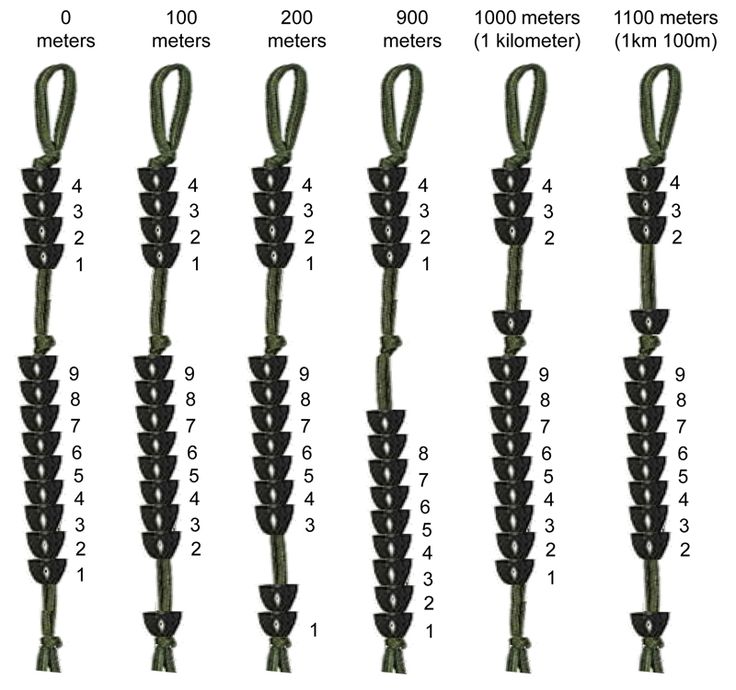
A standard ranger bead setup usually consists of thirteen beads attached to a cord. The beads are divided into two sections. The lower section commonly contains nine beads, while the upper section contains four. Each section serves a specific purpose in distance tracking.
The lower beads are generally used to track smaller distance increments. In military navigation, one lower bead typically represents 100 meters traveled. After moving 100 meters, one bead is pulled downward. After another 100 meters, another bead is moved. Once all nine lower beads are used, the traveler has covered 900 meters.
When the tenth 100-meter increment is reached, the lower beads reset, and one upper bead is moved instead. Each upper bead commonly represents 1 kilometer traveled. This system allows users to track long distances efficiently without needing to memorize large numbers or constantly stop to write information down.
The simplicity of ranger beads is what makes them so effective. They require no batteries, produce no light, and function in nearly any weather condition. Rain, snow, mud, and cold temperatures that might damage electronics rarely affect a basic set of beads.
Learning your personal pace count is the first step toward using ranger beads properly. Pace count refers to the number of steps it takes you to travel a specific distance, usually 100 meters. Because every person walks differently, no universal pace count exists. Height, stride length, terrain, equipment weight, and fatigue all influence the number.
To determine your pace count, a measured 100-meter course is typically used. Walking naturally while counting every time your left foot strikes the ground provides a consistent counting method. Some people count every step, while others count only one foot to reduce mental strain over long distances.
After repeating the process several times, an average pace count emerges. A person may discover, for example, that it takes 62 left-foot steps to cover 100 meters on flat terrain. Once this number is known, ranger beads become a practical tool for tracking movement.
Terrain changes significantly affect pace count accuracy. Walking uphill shortens stride length and increases the number of steps required to cover a distance. Thick brush, mud, snow, and rocky terrain all slow movement and alter pacing. Downhill movement may reduce step count because longer strides become possible.
Experienced navigators understand that pace count is never perfectly exact. Instead, it provides a consistent estimate that becomes increasingly useful when combined with map reading and compass work. Ranger beads are most effective when used alongside strong navigation habits rather than as a standalone system.
Night navigation demonstrates the true value of ranger beads better than almost any other scenario. Darkness removes many visual references people normally rely on. Distances become difficult to judge, terrain features disappear into shadows, and movement often slows dramatically. Under these conditions, pace counting helps maintain awareness of position even when visibility becomes poor.
Dense forests create similar challenges. Thick vegetation can block landmarks and distort directional awareness. Many people underestimate how easy it is to drift off course while walking through wooded terrain. Small directional errors become larger over distance, especially when obstacles force constant route adjustments. Ranger beads help reduce uncertainty by allowing travelers to track approximate movement even when surroundings appear repetitive.
Military forces have used pace counting systems for decades because of their reliability under stress. Soldiers moving through unfamiliar terrain at night often depend on ranger beads to maintain navigation accuracy while carrying heavy equipment under difficult conditions. In survival situations, simple tools that work consistently become extremely valuable.
Search-and-rescue teams also benefit from pace counting techniques. In large wilderness areas where GPS signals may weaken or environmental conditions interfere with electronics, having backup navigation skills improves operational reliability. Technology works best when supported by traditional skills rather than replacing them entirely.
One of the advantages of ranger beads is how easy they are to customize. Some people build their own using paracord and small beads, while others purchase professionally made versions attached to compasses, backpacks, or watches. Colors, bead sizes, and layouts vary depending on personal preference.
Homemade ranger beads are popular because they are inexpensive and simple to construct. A short length of paracord with knots separating bead sections creates a durable navigation tool in just a few minutes. Some survivalists integrate ranger beads directly into survival bracelets or gear straps so they remain easily accessible during movement.
Ranger beads also encourage mental discipline and environmental awareness. Modern GPS devices often tempt people to follow screens passively without truly understanding the terrain around them. Pace counting forces navigators to stay mentally engaged with movement, direction, and surroundings. This active awareness improves overall navigation ability over time.
Despite their usefulness, ranger beads are not magic tools. They require practice and consistency to use effectively. Beginners often lose track of counts, forget to move beads, or struggle to maintain accurate pacing over rough terrain. Like any survival skill, proficiency develops through repetition and field experience.
Fatigue also affects navigation performance. Long-distance movement, heavy packs, poor weather, and stress all reduce concentration. Experienced outdoorsmen periodically verify their location using terrain features, maps, and compass bearings instead of depending entirely on pace count alone.
Map and compass skills remain essential companions to ranger beads. A pace count tells you how far you have traveled, but without direction and terrain association, distance alone provides limited value. Successful land navigation combines multiple methods together: compass bearings maintain direction, maps provide terrain understanding, and ranger beads help estimate distance traveled.
One of the greatest strengths of ranger beads is their reliability during emergencies. In survival situations, simplicity often outperforms complexity. Electronic devices may fail unexpectedly, but a cord and a few beads continue functioning regardless of battery life or weather conditions.
Preparedness-minded outdoorsmen appreciate tools that remain dependable under stress. Ranger beads weigh almost nothing, cost very little, and require almost no maintenance. Yet they can dramatically improve navigation confidence during wilderness travel.
Many people entering the outdoors focus heavily on gear while overlooking skills. Bushcraft and survival communities often emphasize that knowledge weighs nothing and cannot break. Ranger beads represent that philosophy perfectly. The beads themselves are simple, but the real value comes from understanding how to use them effectively.
The wilderness has a way of exposing overconfidence quickly. Dense forests, fog, storms, snow, and darkness can make familiar terrain suddenly confusing. Under those conditions, maintaining orientation becomes critical. Knowing approximately how far you have traveled may help prevent dangerous mistakes and wasted energy.
Ranger beads may seem old-fashioned in a world dominated by satellites and smartphones, but their continued use proves an important lesson: simple tools remain valuable because simple tools often work when everything else fails.
In survival situations, reliability matters more than sophistication.
And sometimes a few small beads on a cord can help guide you safely through the wilderness when technology no longer can.