By Survival Boys Editorial Team
When most people imagine a homestead, they picture massive farms, endless fields, barns full of livestock, and hundreds of acres stretching beyond the horizon. That image has become deeply tied to the idea of self-reliance. But modern homesteading is changing. Rising land prices, suburban living, and limited space have forced many families to rethink what true self-sufficiency really looks like.
The reality is that a surprising amount of food and independence can be created on just a quarter of an acre of land.
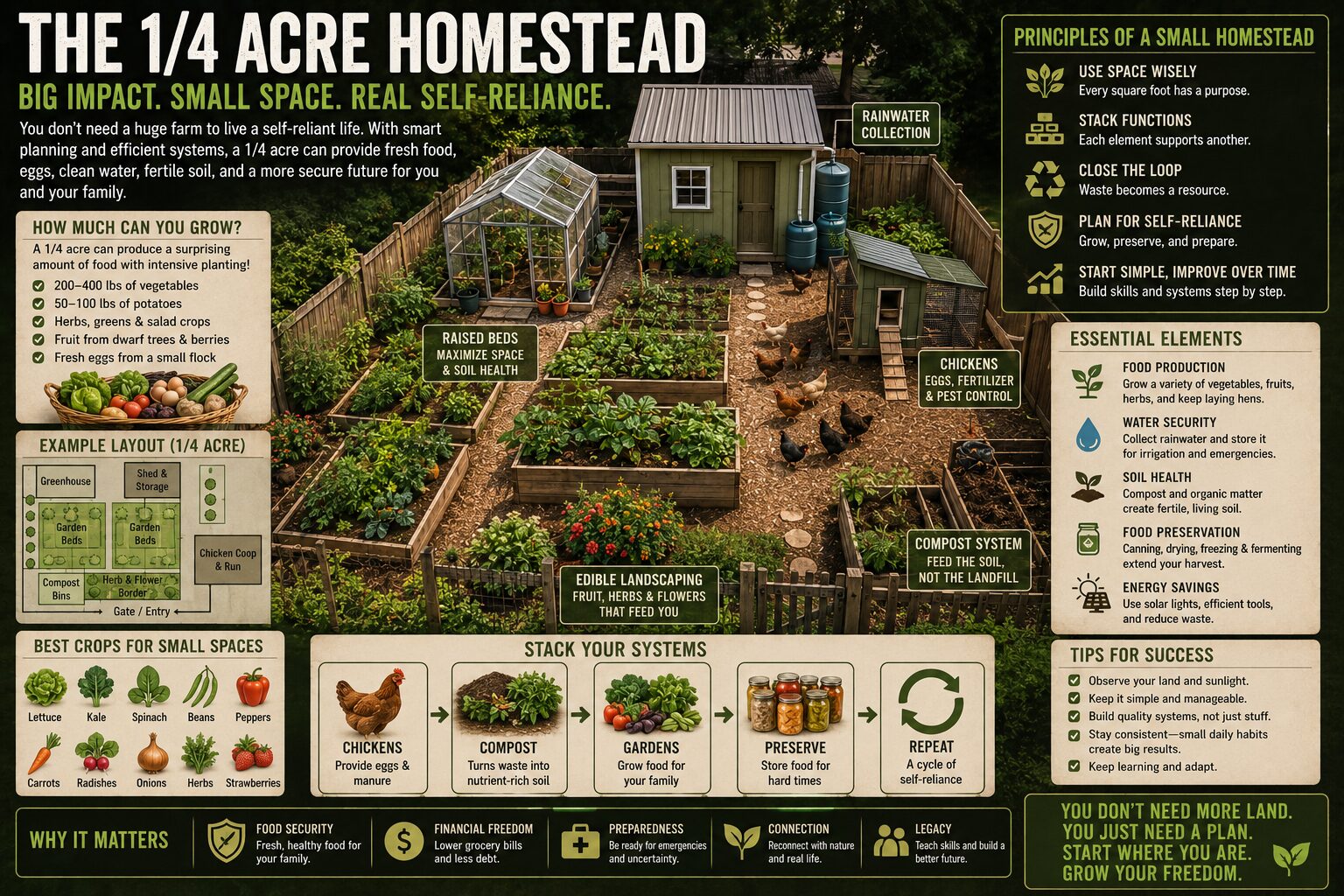
A 1/4 acre homestead may seem small at first glance, but with smart planning, efficient systems, and careful use of space, it can support gardens, chickens, water collection, composting, food preservation, and even small-scale energy production. For many preparedness-minded families, small homesteads provide a realistic path toward greater resilience without requiring huge amounts of land or money.

The key to a successful small homestead is efficiency. Every square foot matters. Instead of relying on large-scale farming methods, small-property homesteaders focus on layering systems together so each part supports the others. Gardens feed families while scraps feed chickens. Chickens provide eggs and fertilizer for compost. Rainwater collection supports irrigation. Compost enriches the soil. Nothing goes to waste when space is limited.
One of the biggest misconceptions about homesteading is that more land automatically means more success. In reality, larger properties often require more equipment, more maintenance, and more labor. A smaller homestead forces people to think carefully about sustainability and productivity instead of expansion alone.
Food production usually becomes the heart of a 1/4 acre homestead. Raised garden beds are extremely popular because they maximize growing space while improving soil quality and reducing weeds. Intensive gardening methods allow vegetables to grow closer together than traditional row farming, increasing yields in compact areas.
Tomatoes, peppers, lettuce, beans, potatoes, carrots, onions, cucumbers, and herbs all perform well in small homestead gardens when managed properly. Vertical gardening also becomes important. Trellises, hanging planters, and stacked growing systems allow crops to grow upward instead of outward, dramatically increasing productivity in limited space.
Fruit trees and berry bushes add another layer of food production. Dwarf fruit trees are especially valuable because they provide harvests without taking up the massive space required by full-sized orchard trees. Blueberries, blackberries, raspberries, and strawberries produce large amounts of food while fitting easily into fence lines and corners of the property.
Many small homesteaders also integrate edible landscaping into the yard itself. Instead of decorative plants with no practical value, they grow herbs, vegetables, fruit trees, and medicinal plants throughout the property. A front yard can become both attractive and productive at the same time.
Chickens are often the first livestock added to a 1/4 acre homestead because they provide reliable food without requiring large grazing areas. A small flock can produce fresh eggs almost daily while also contributing fertilizer for gardens and compost systems. Chickens naturally recycle food scraps, helping reduce waste while supporting food production.
Because space is limited, predator-proof coop design becomes extremely important. Urban and suburban environments still contain threats like raccoons, stray dogs, hawks, snakes, and rodents. Strong fencing, secure coop doors, and covered runs help protect flocks while keeping operations manageable in tighter spaces.
Some small homesteaders also raise rabbits because they require little room, reproduce quickly, and provide both meat and fertilizer. Rabbit manure can be used directly in gardens without composting, making it valuable for small-scale food production systems.
Water management becomes another major priority on small homesteads. Municipal water systems may work normally most of the time, but preparedness-minded families understand the importance of backup systems. Rainwater collection barrels connected to roof gutters provide irrigation water while reducing utility dependence.
Even a small roof can collect surprising amounts of rainwater during storms. Stored water becomes valuable during droughts, emergencies, or rising utility costs. Some advanced setups include filtration systems, underground cisterns, and solar-powered pumps for increased resilience.
Composting is one of the most powerful tools available to a small homestead. Kitchen scraps, leaves, grass clippings, garden waste, and chicken manure all become nutrient-rich compost instead of garbage. Healthy compost dramatically improves soil quality over time, allowing gardens to produce more food without relying heavily on store-bought fertilizers.
Good soil is one of the foundations of self-reliance. A productive garden depends less on expensive equipment and more on healthy living soil capable of retaining water and nutrients naturally.
Many small homesteaders also focus heavily on food preservation because growing food means little if harvests spoil quickly. Canning, dehydrating, fermenting, freezing, and root cellaring extend harvests far beyond the growing season. Shelves lined with preserved vegetables, sauces, jams, and dried foods become both practical food storage and visible evidence of preparedness.
Energy independence also attracts many people to small homestead living. Solar panels, backup batteries, wood stoves, and energy-efficient systems help reduce dependence on outside utilities. While full off-grid living may not always be realistic on smaller suburban properties, even partial energy independence improves resilience during outages and emergencies.
One of the greatest advantages of a 1/4 acre homestead is manageability. Large farms often require tractors, heavy equipment, fencing repairs, and constant maintenance. Smaller homesteads allow families to focus more on quality systems and hands-on care without becoming overwhelmed.
This also makes homesteading more accessible for beginners. Many people become intimidated by the idea of managing large acreage, but smaller properties allow gradual learning. Mistakes become easier to correct, startup costs remain lower, and systems can expand over time as experience grows.
However, small-space homesteading also requires discipline and planning. Storage becomes important because tools, feed, seeds, preserved food, and supplies must fit efficiently into limited areas. Clutter quickly creates problems when every part of the property serves multiple purposes.
Time management matters too. Small homesteads may require less physical land management, but they still demand consistency. Gardens need watering, chickens need feeding, compost requires maintenance, and repairs never completely stop. Homesteading is a lifestyle built around daily routines and long-term thinking rather than instant results.
Neighbors also become an important consideration in suburban or semi-rural homesteading. Noise, odors, fencing, and property appearance can create tension if poorly managed. Responsible homesteaders maintain clean, organized spaces while respecting local regulations and community relationships.
One of the most overlooked benefits of homesteading is mental resilience. Modern life often disconnects people from practical skills and natural cycles. Growing food, caring for animals, preserving harvests, and working outdoors create a stronger sense of independence and accomplishment. During uncertain times, those skills provide confidence that cannot be purchased in stores.
A small homestead also teaches valuable survival lessons naturally. The weather affects crops. Equipment breaks unexpectedly. Predators target livestock. Water shortages happen. Homesteaders learn adaptation because nature constantly presents challenges that require problem-solving and preparation.
Preparedness becomes part of daily life instead of something theoretical. A stocked pantry, functioning garden, rain barrels, and healthy chickens all contribute to long-term security in practical ways.
For many families, the goal of a 1/4 acre homestead is not complete isolation from society. Instead, it is about reducing vulnerability. Every tomato grown at home, every egg collected from the coop, and every jar of preserved food on the shelf represents one less dependency on fragile outside systems.
In uncertain economic times, that kind of resilience becomes increasingly valuable.
The beauty of a small homestead is that it proves self-reliance does not require massive land ownership or enormous wealth. A carefully planned quarter-acre can provide food, skills, security, and a deeper connection to the essentials of life.
True preparedness is not measured only by how much land someone owns.
It is measured by how well they use the land they have.