When you think about survival food, you might picture freeze-dried meals, canned goods, rice, beans, or buckets of emergency food. But one of the oldest survival foods ever created is remarkably simple: flour, water, and salt.
That food is called hardtack.
Sometimes called survival bread, hardtack has been used by soldiers, sailors, explorers, pioneers, and travelers for hundreds of years. It wasn’t designed to be delicious. It was designed to do something far more important—it was designed to last.
For anyone building a long-term emergency food supply, hardtack is an interesting reminder that survival food doesn’t have to be complicated.

What Is Hardtack?
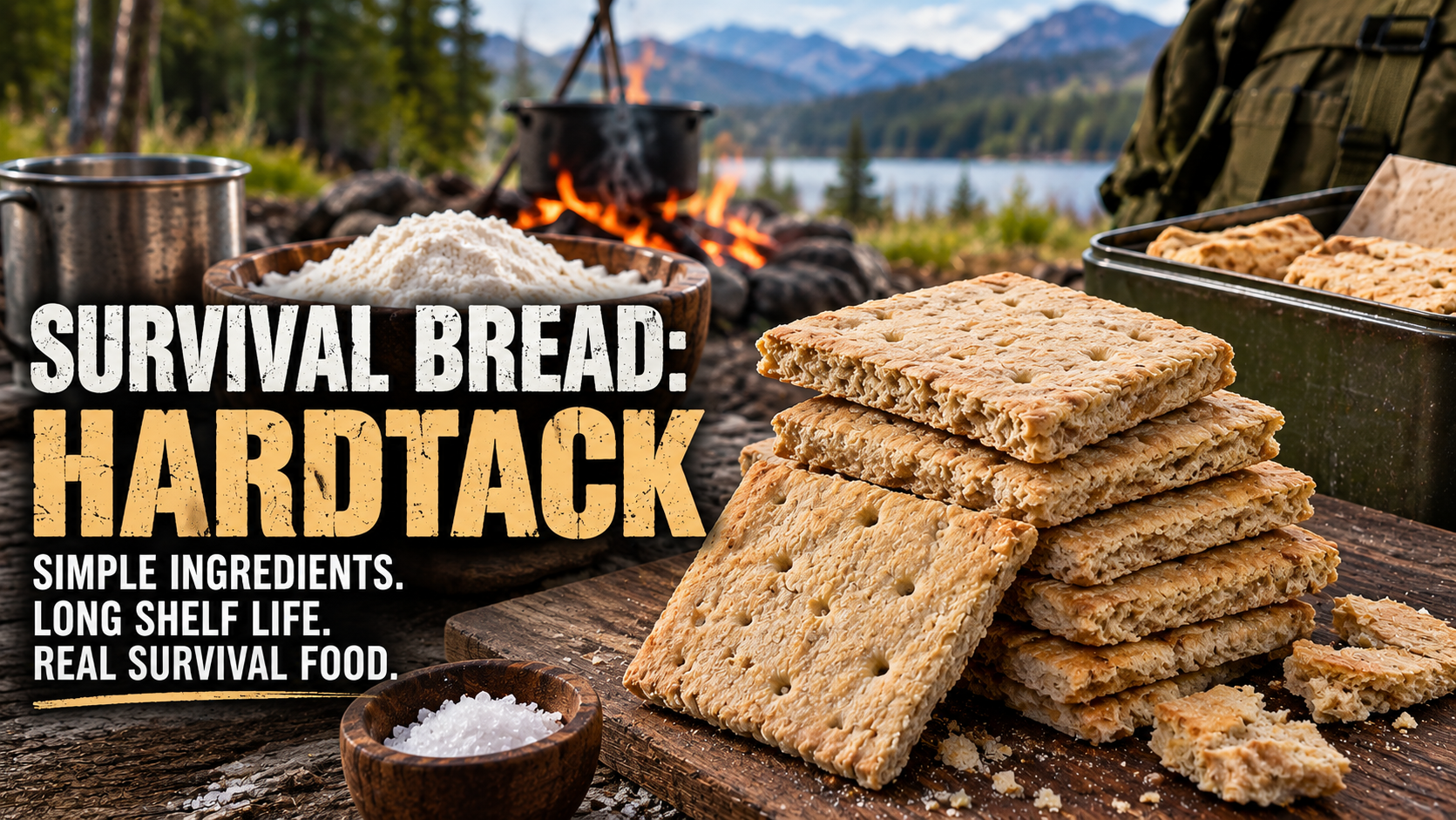
Hardtack is an extremely dry, dense cracker or biscuit made primarily from flour and water, sometimes with salt added. The dough is rolled flat, cut into pieces, and baked until much of the moisture has been removed.
That lack of moisture is the secret.
Most foods spoil because microorganisms need moisture to grow. By baking hardtack until it is extremely dry, you create a food that can remain edible for a very long time when properly stored.
Historically, hardtack became especially important for military rations and long sea voyages. Soldiers and sailors could carry it for months without refrigeration.
The downside was obvious: hardtack is hard.
Really hard.
It was commonly softened before eating by soaking it in water, coffee, broth, or another liquid. Some people simply broke it into pieces and added it to other foods.
The goal wasn’t gourmet food.
The goal was calories that would still be there when everything else was gone.
Why Hardtack Works as Survival Food
A good emergency food should have several characteristics.
It should be inexpensive, relatively easy to make, compact, resistant to spoilage, and capable of being stored without refrigeration.
Hardtack checks many of those boxes.
Flour is inexpensive and widely available. Salt is inexpensive and naturally shelf-stable. The preparation process requires basic cooking equipment, and the finished product can be stored in airtight containers.
Most importantly, hardtack doesn’t depend on modern refrigeration.
That makes it particularly interesting for preparedness situations involving extended power outages, supply-chain disruptions, camping, or emergency evacuation.
However, there’s an important distinction:
Hardtack is a long-term survival food, not a nutritionally complete diet.
It is primarily a source of carbohydrates. Living exclusively on it would leave you short on important nutrients, fats, protein, vitamins, and minerals.
Think of hardtack as one component of a larger emergency food system.
A Simple Hardtack Recipe
Traditional recipes can be extremely simple.
Ingredients
- 4 cups all-purpose flour
- 1½ cups water, approximately
- 1 teaspoon salt
That’s it.
The exact amount of water can vary depending on the flour and conditions. You want a very stiff dough, not a soft bread dough.
Mix the flour and salt together, then gradually add water until the mixture comes together.
Knead it until you have a firm, uniform dough.
Don’t be tempted to make it soft.
The objective is to create a dense cracker that can be dried thoroughly.
Preparing the Dough
Roll the dough out to roughly ¼ inch thick.
Cut it into squares or rectangles approximately 3–4 inches across.
Then comes one of the most recognizable features of hardtack: the holes.
Use a fork, skewer, or similar clean tool to make several holes through each piece.
These holes allow steam and moisture to escape during baking and help the pieces dry more evenly.
Place the pieces on a baking sheet.
Baking Hardtack
Bake the pieces at approximately 375°F for around 30 minutes.
Then turn them over and continue baking until they are thoroughly dry.
The exact time depends on thickness, oven performance, and moisture content.
For long-term storage, the important thing isn’t simply reaching a certain baking time.
The hardtack needs to be extremely dry.
If the center remains soft or flexible, it contains moisture that can contribute to spoilage during storage.
After baking, allow the pieces to cool completely.
For the longest storage life, some traditional approaches involve additional low-temperature drying after the initial baking. The objective is to remove as much residual moisture as practical without burning the product.
How to Store Hardtack
Storage is just as important as the recipe.
After the hardtack has completely cooled and dried, place it in an airtight container.
Good options include sealed food-grade containers, vacuum-sealed bags, or properly packaged Mylar bags with an appropriate oxygen absorber.
Keep the finished product somewhere cool, dry, and dark.
Moisture is your enemy.
If condensation develops inside the package, the food wasn’t adequately dried or the packaging/storage conditions introduced moisture.
Inspect stored hardtack periodically for signs of mold, insects, unusual odors, or moisture.
If you see mold or significant spoilage, don’t try to salvage it by scraping off the affected area.
Throw it away.
How Do You Eat Something That Hard?
This is where hardtack earns its name.
Instead of biting directly into a whole piece, break it into smaller pieces.
You can then soak it in water, coffee, soup, stew, or broth until it softens.
Another option is to crush it into smaller pieces and incorporate it into other foods.
Hardtack can provide bulk and carbohydrates to a meal while making other emergency foods go farther.
For camping or emergency situations, adding softened hardtack to a soup or stew can turn a simple meal into something considerably more filling.
Hardtack for a Bug-Out Bag
Would hardtack be useful in a bug-out bag?
Potentially.
It’s compact, inexpensive, and doesn’t require refrigeration.
But there’s one major consideration: weight versus calories and nutrition.
Modern energy bars, dehydrated meals, nut butters, trail mixes, and other foods may provide more balanced nutrition.
Hardtack makes more sense as part of a broader emergency food supply than as your only food.
For example, a preparedness pantry could combine hardtack with:
- Beans
- Rice
- Canned meats
- Peanut butter
- Dried fruits
- Oats
- Powdered milk
- Salt
- Multivitamins
- Other shelf-stable foods
This gives you a much more balanced system.
The Bigger Lesson of Hardtack
Hardtack isn’t impressive because it tastes great.
It’s impressive because it demonstrates a fundamental survival principle:
Simple systems can be incredibly resilient.
You don’t need electricity, refrigeration, expensive equipment, or complicated ingredients to create a food capable of lasting a long time.
Flour, water, salt, heat, and proper storage can produce an emergency staple that has been relied upon for generations.
Modern survival technology is valuable, but traditional knowledge still matters.
If the power goes out for a few days, hardtack may seem unnecessary.
If a disaster disrupts transportation and food deliveries for weeks or months, suddenly knowing how to produce and preserve simple foods becomes much more valuable.
That’s the real lesson behind survival bread.
Prepare before you need it. Learn the skill before the emergency. And build a food supply that doesn’t depend entirely on the systems around you.
Hardtack may be one of the simplest survival foods ever created—but sometimes simple is exactly what you want when everything else stops working.
Survival isn’t about having the perfect equipment. It’s about having options.