
Practical Preparedness. Self-Reliance. No Fluff.
What if you didn’t need 10, 20, or even 50 acres to produce a significant portion of your own food?
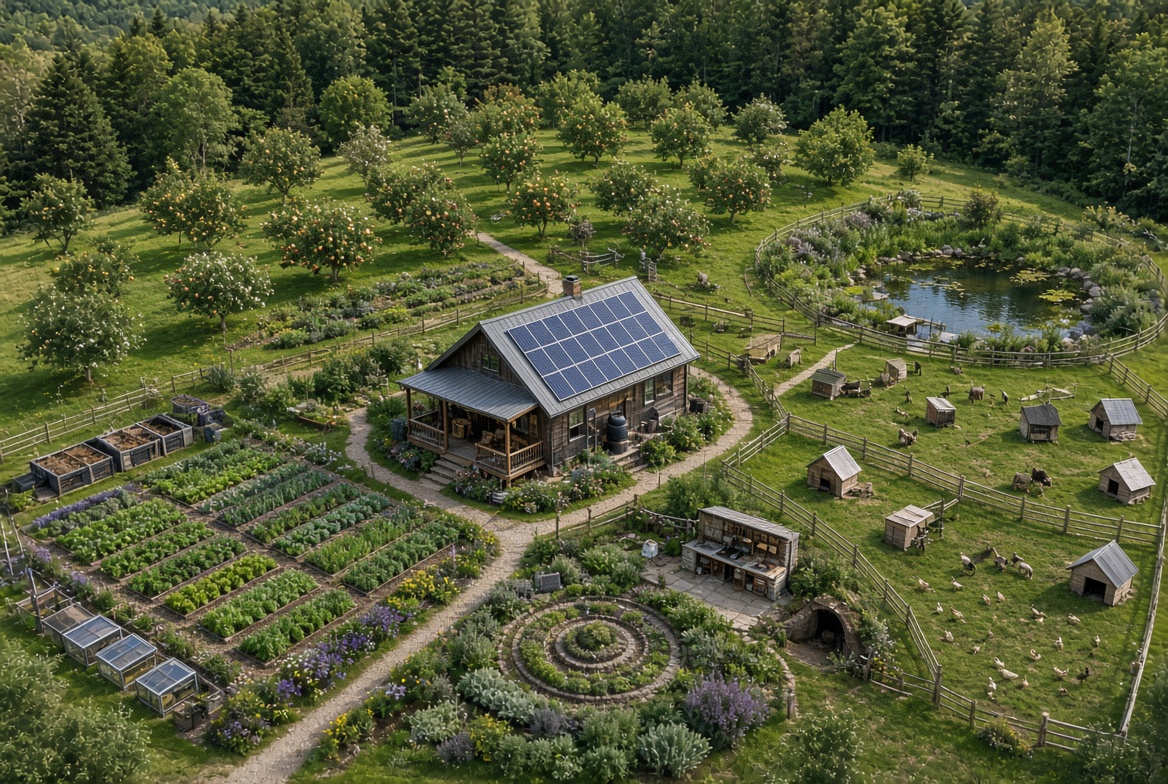
Imagine having a property where you grow vegetables, raise chickens, collect rainwater, produce fruit, preserve food, and generate enough resources to become less dependent on grocery stores. All of this could be accomplished on just one acre.
A well-designed one-acre survival farm isn’t about creating a traditional farm. It’s about building a compact, productive homestead that provides food, water, energy, and practical resources for your household.

Whether you’re preparing for economic uncertainty, supply chain disruptions, severe weather, or simply want to become more self-reliant, one acre can provide an impressive foundation.
Let’s look at how to design the ideal one-acre survival farm.
1. Divide the Acre Into Productive Zones
The biggest mistake people make is treating their entire property as one large garden. An effective survival farm needs organization.
One acre contains approximately 43,560 square feet. Every section should serve a purpose.
A practical layout could look like this:
| Area | Approximate Size | Primary Purpose |
|---|---|---|
| Vegetable gardens | 10,000 sq. ft. | Daily food production |
| Fruit orchard and berries | 8,000 sq. ft. | Long-term food production |
| Chicken area | 3,000 sq. ft. | Eggs, meat, compost |
| Greenhouse and nursery | 1,500 sq. ft. | Year-round growing |
| Root cellar and storage | 1,000 sq. ft. | Preserving food |
| House and living space | 5,000 sq. ft. | Shelter and utilities |
| Water collection and storage | 2,000 sq. ft. | Water security |
| Compost and utility area | 1,500 sq. ft. | Soil and waste management |
| Paths and flexible space | 11,560 sq. ft. | Access and expansion |
The exact layout depends on the property’s shape, sunlight, drainage, climate, and local regulations.
The goal is to make every square foot productive without overcrowding the property.
2. Build a Vegetable Garden That Produces Food
The vegetable garden should be the centerpiece of your survival farm.
Instead of planting everything in traditional rows, use raised beds, intensive planting, succession planting, and vertical growing systems.
Prioritize crops that provide calories, nutrition, and reliable harvests.
High-priority survival crops include:
- Potatoes and sweet potatoes
- Corn
- Dry beans and peas
- Winter squash
- Tomatoes
- Carrots
- Onions and garlic
- Cabbage
- Kale
- Peppers
- Cucumbers
- Zucchini
Potatoes, sweet potatoes, dry beans, and winter squash deserve special attention because they provide substantial food value and can be stored.
Plant crops at different times throughout the growing season instead of harvesting everything at once.
For example, plant lettuce and radishes in succession every few weeks. This creates a continuous supply rather than one large harvest followed by an empty garden.
Use trellises for beans, cucumbers, and other climbing plants to increase production without consuming additional ground space.
3. Establish a Small Fruit Orchard
Fruit trees are one of the best long-term investments on a survival homestead.
Once established, they can produce food for years with proper maintenance.
For a warm climate such as the Gulf Coast, consider:
- Fig trees
- Peach trees
- Pear trees
- Persimmons
- Citrus varieties suited to your location
- Muscadine grapes
- Blueberries
- Blackberries
- Strawberries
Plant dwarf or semi-dwarf varieties where appropriate to maximize available space.
Consider planting several varieties with different harvest seasons. This spreads production throughout the year.
Fruit can also be preserved through dehydration, freezing, canning, and other appropriate food-preservation methods.
Don’t forget perennial plants. Asparagus, herbs, and perennial berries can provide recurring harvests without requiring annual replanting.
4. Raise Chickens for Eggs and Meat
A small chicken operation can provide a valuable source of protein.
Start with approximately 8–12 laying hens.
Depending on breed, age, season, and management, a healthy flock could produce several dozen eggs per week during productive periods.
Consider dual-purpose breeds such as:
- Barred Rock
- Rhode Island Red
- Australorp
- Plymouth Rock
Build a secure coop with ventilation, predator protection, nesting boxes, and adequate roosting space.
A movable chicken run can help distribute manure and reduce pressure on the ground.
Chicken manure can also become valuable garden fertilizer after proper composting.
If local regulations and available space permit, you could eventually add meat birds.
Remember that chickens still require dependable feed, clean water, and protection from predators. A flock is a food-producing system, not a completely independent source of food.
5. Install a Greenhouse for Year-Round Production
A greenhouse extends your growing season and gives you greater control over food production.
A 10-by-20-foot greenhouse provides 200 square feet of growing space.
Inside, you could grow:
- Seedlings for the outdoor garden
- Tomatoes
- Peppers
- Leafy greens
- Herbs
- Cucumbers
- Microgreens
Consider adding vertical shelving and simple hydroponic systems.
A small greenhouse can also serve as a nursery for fruit trees, replacement plants, and seedlings.
In hot climates, ventilation, shade cloth, and temperature management are essential. A greenhouse that overheats can destroy crops rather than protect them.
6. Develop an Independent Water Supply
Food production means nothing without water.
Water security should be one of the first priorities when developing a survival farm.
Consider combining several systems:
Rainwater harvesting: Install gutters on the house, greenhouse, and outbuildings. Direct collected water into covered storage tanks.
Well water: If permitted and feasible, a properly constructed well can provide a dependable water source.
Water storage: Keep emergency water reserves in properly maintained, food-grade containers.
Filtration: Maintain a drinking-water treatment system capable of addressing the contaminants found in your source water.
Irrigation: Use drip irrigation to reduce water waste and deliver water directly to plant roots.
A 1,000-square-foot roof receiving one inch of rain can collect approximately 623 gallons before collection losses.
That is a significant amount of water from a relatively small roof.
However, rainwater collection should supplement—not automatically replace—a reliable drinking-water source. Treatment, testing, and safe storage are essential.
7. Build a Composting and Soil Management System
Healthy soil is the foundation of long-term food production.
Instead of constantly purchasing fertilizer, establish a composting system.
Useful materials include:
- Vegetable scraps
- Leaves
- Grass clippings
- Chicken manure after appropriate composting
- Straw
- Wood chips
- Garden waste
Create separate compost areas for active composting and finished material.
Consider adding a worm-composting system for producing nutrient-rich castings.
Mulching garden beds helps retain moisture, suppress weeds, and protect soil.
A soil test should guide fertilizer and amendment decisions. Don’t assume that adding more organic material automatically produces better soil.
The objective is to build soil that becomes more productive every year.
8. Preserve Food for Emergencies
Growing food is only half the equation. You also need to preserve it.
A survival farm should have a dedicated food-preservation area.
Prioritize:
- Pressure canning low-acid vegetables and meats using tested procedures
- Water-bath canning appropriate high-acid foods
- Dehydrating fruits and vegetables
- Freezing surplus harvests
- Storing dry beans, rice, grains, and other staples
- Root-cellar storage for suitable crops
A root cellar or cool storage room can extend the storage life of potatoes, carrots, onions, and winter squash when properly designed.
Build your food reserves gradually.
The first goal should be a 30-day emergency food supply, followed by 90 days, and eventually six months or more.
Remember that a freezer depends on electricity. Keep alternative preservation methods available.
9. Add Solar Power and Backup Energy
A self-sufficient homestead should not depend entirely on the electrical grid.
A modest solar system can provide electricity for essential equipment.
Consider powering:
- Water pumps
- Refrigeration
- Lighting
- Communications
- Greenhouse ventilation
- Small appliances
- Battery-powered tools
A battery bank provides electricity when sunlight is unavailable, while a backup generator can provide additional security during extended cloudy periods.
Prioritize essential loads rather than attempting to power an entire conventional household without careful planning.
Also consider a small workshop with basic tools for repairing equipment, maintaining fencing, and building replacement components.
10. Design the Farm for Long-Term Survival
The ideal one-acre survival farm is more than a collection of gardens and chickens.
It is an interconnected system.
Chicken manure supports compost production. Compost improves garden soil. Garden waste feeds the compost system. Rainwater supports irrigation. Solar power operates essential equipment. Fruit trees and perennial crops provide recurring harvests.
Every component should support another component.
However, don’t try to build everything at once.
Start with the essentials:
- Establish a dependable water supply.
- Prepare the soil and install the vegetable garden.
- Plant fruit trees and perennial crops.
- Build the chicken coop.
- Install rainwater collection.
- Add food-preservation equipment.
- Expand into greenhouse production.
- Install solar and backup power.
- Build long-term food storage.
This approach allows the property to become more productive as your skills and resources grow.
Final Thoughts: One Acre Can Change Your Level of Preparedness
You don’t need hundreds of acres to become more self-reliant.
One carefully planned acre can provide vegetables, fruit, eggs, preserved food, water storage, and supplemental energy.
It won’t necessarily provide every calorie your household needs, and true food independence requires careful planning, adequate storage, livestock feed, and consistent production.
But it can dramatically reduce your dependence on outside supply chains.
The most important investment isn’t the land itself. It’s the systems, knowledge, and skills you develop on that land.
Start small. Build intelligently. Expand gradually.
Because when supply chains fail, the people who know how to produce their own food have an advantage.
Survival Boys — No Fluff. Just Survival.