How to Navigate Using a Compass, Map, and Natural Signs
Getting lost is one of the fastest ways to turn a simple outdoor adventure into a survival situation. Every year, experienced hikers, hunters, campers, and outdoor enthusiasts find themselves disoriented because they relied too heavily on GPS devices or failed to develop basic navigation skills.
Technology is useful, but batteries die, signals disappear, and electronics can fail when you need them most. That’s why every survivalist should understand traditional navigation methods, especially compass navigation.
In this guide, you’ll learn the fundamentals of wilderness navigation, how to use a compass correctly, and what to do if you find yourself lost in the outdoors.
Why Navigation Matters
Survival is often about reaching safety. Whether you’re trying to return to camp, locate a road, find a water source, or reach a rescue point, navigation skills can save your life.

Without a plan or sense of direction, people often walk in circles, waste energy, become dehydrated, and make poor decisions due to stress.
The ability to determine your location and travel in the correct direction provides confidence and dramatically improves your chances of survival.
The Three Basic Navigation Tools
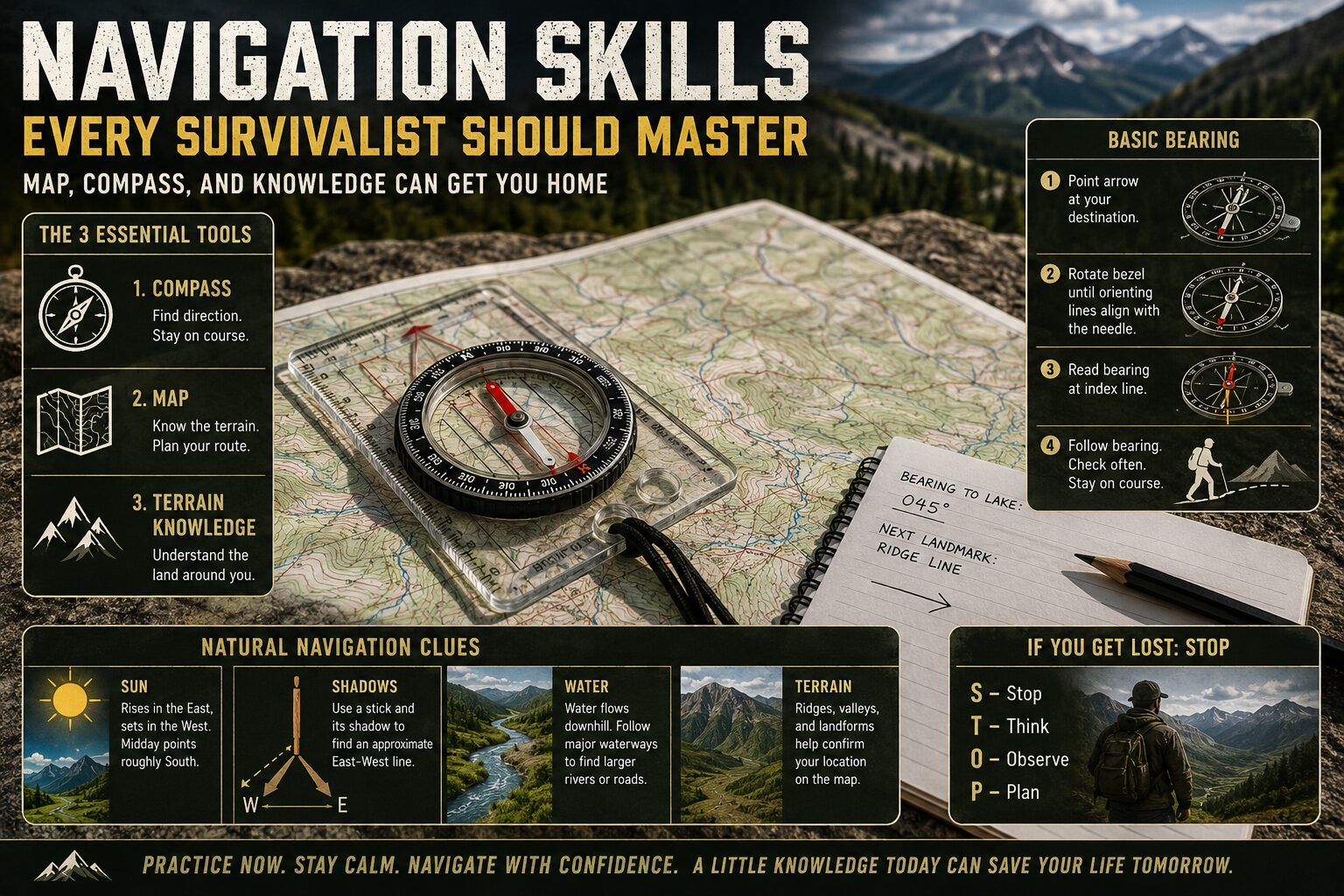
Traditional navigation relies on three primary tools:
- A compass
- A topographic map
- Knowledge of terrain
While modern GPS devices can be useful, these three tools have guided explorers, hunters, soldiers, and outdoorsmen for centuries.
Understanding Your Compass
360^\circ
A compass is a simple device that points toward magnetic north. Most survivalists use a baseplate compass because it is lightweight, reliable, and easy to use.
The main parts of a compass include:
- Magnetic needle
- Direction of travel arrow
- Rotating bezel
- Degree markings
- Baseplate
The compass needle always aligns itself with Earth’s magnetic field. The red end points toward magnetic north.
The bezel is marked with degrees from 0 to 360.
- North = 0° or 360°
- East = 90°
- South = 180°
- West = 270°
Learning these basic directions is the foundation of compass navigation.
Taking a Bearing
A bearing is the direction you want to travel.
To take a bearing:
- Hold the compass flat.
- Point the direction of travel arrow toward your destination.
- Rotate the bezel until the orienting lines align with the needle.
- Read the degree marking at the index line.
If the bearing reads 90 degrees, your destination is due east.
Once you have your bearing:
- Keep the needle aligned with the orienting arrow.
- Walk in the direction indicated by the travel arrow.
- Periodically stop and recheck your heading.
This simple technique can keep you traveling in a straight line over long distances.
Avoiding the “Walking in Circles” Problem
One of the most common mistakes made by lost hikers is unknowingly walking in circles.
Humans naturally drift left or right due to uneven stride length, terrain obstacles, and physical fatigue.
Using a compass eliminates this problem.
Pick a landmark directly on your bearing such as:
- A tree
- A rock
- A hilltop
Walk to that landmark, then choose another. This method keeps you on course without constantly staring at the compass.
How to Read a Topographic Map
A topographic map shows terrain features using contour lines.
These lines represent elevation changes.
When contour lines are close together:
- Terrain is steep.
When contour lines are far apart:
- Terrain is relatively flat.
Topographic maps also display:
- Rivers and streams
- Roads and trails
- Lakes and ponds
- Mountain ridges
- Valleys
- Man-made structures
Learning to identify these features allows you to match what you see around you with what appears on the map.
Orienting a Map
Before using a map, orient it to match the terrain.
Place the map on a flat surface.
Lay your compass on the map and rotate both until the map’s north aligns with the compass needle.
Now the map reflects the actual direction of the terrain around you.
This makes identifying landmarks much easier.
Finding Your Location
One useful navigation technique is called triangulation.
Find two visible landmarks that also appear on your map.
Examples include:
- Mountain peaks
- Radio towers
- Lakes
- Distinct ridges
Take a compass bearing to each landmark.
Plot those bearings on the map.
The point where the lines intersect is your approximate location.
Hunters, search-and-rescue teams, and military personnel use this method regularly.
Terrain Association
Many experienced outdoorsmen navigate primarily by terrain.
This method involves recognizing natural features and comparing them to the map.
Pay attention to:
- Ridge lines
- Valleys
- Streams
- Hilltops
- Saddles between mountains
Rather than relying solely on compass bearings, terrain association helps you understand the bigger picture of your surroundings.
It is often faster and more efficient than navigating strictly by compass.
Natural Navigation Methods
A compass should always be your primary navigation tool, but knowing natural navigation techniques can provide backup information.
Using the Sun
The sun rises generally in the east and sets generally in the west.
Around midday in North America, the sun will be roughly toward the south.
While not precise enough for detailed navigation, the sun can help maintain general direction.
Using Shadows
Place a stick vertically in the ground.
Mark the tip of the shadow.
Wait about 20 minutes and mark the new shadow position.
The line between the two marks provides an approximate east-west direction.
Observing Terrain and Waterways
Water usually flows downhill toward larger streams and rivers.
Following a major waterway often leads toward roads, bridges, settlements, or populated areas.
However, avoid traveling through dangerous canyons, flood-prone areas, or steep riverbanks.
Navigation During Emergencies
If you realize you’re lost:
Stop immediately.
The survival acronym STOP can help:
S – Stop
T – Think
O – Observe
P – Plan
Panic causes poor decisions and wastes valuable energy.
Instead:
- Stay calm
- Check your map
- Use your compass
- Identify landmarks
- Determine your last known location
Often the safest choice is to backtrack to a known point rather than continue wandering.
Essential Navigation Gear
Every survival kit should include:
- Quality baseplate compass
- Waterproof topographic maps
- Pencil and notebook
- Signal mirror
- Whistle
- GPS device (optional)
- Extra batteries
- Waterproof map case
These items weigh very little but can dramatically improve your chances of finding your way.
Common Navigation Mistakes
Many people make the same navigation errors.
Avoid these common mistakes:
- Trusting GPS alone
- Failing to carry a map
- Not practicing compass skills
- Walking without checking direction
- Ignoring terrain features
- Traveling too fast
- Panicking when lost
Navigation is a skill that improves through repetition and practice.
Final Thoughts
Navigation is one of the most important survival skills you can learn. A reliable compass, a quality map, and basic terrain awareness can prevent a minor mistake from becoming a life-threatening emergency.
Technology is helpful, but traditional navigation methods continue to work when batteries fail and signals disappear. Spend time practicing compass bearings, map reading, and terrain association before your next outdoor adventure.
The day you become lost is not the day to learn how to use a compass.
Master these skills now, and you’ll be prepared to confidently find your way home no matter where your journey takes you.
Survival Tip: Carry a compass every time you enter the woods. It weighs only a few ounces but could be the most valuable piece of gear you own.