By Survival Boys Editorial Team
Most people think survival is about gear.
Knives, backpacks, water filters, firearms, flashlights, and emergency food usually dominate conversations about preparedness. While equipment certainly matters, experienced survivalists understand something even more important: mindset determines survival long before gear does.
The human mind becomes either the greatest survival tool or the greatest survival liability during emergencies.

Panic, fear, confusion, and emotional exhaustion have caused far more survival failures than lack of equipment alone. People with excellent gear sometimes make disastrous decisions under stress, while others with very little manage to survive because they remain calm, adaptable, and focused.
The survival mindset is not about acting fearless. It is about functioning despite fear.
Emergencies create chaos quickly. Natural disasters, accidents, getting lost, severe weather, or large-scale emergencies all place enormous stress on the human brain. Adrenaline spikes. Heart rate increases. Clear thinking becomes difficult. Under pressure, many people freeze completely because their minds struggle to process uncertainty.
This reaction is normal.
Humans are wired to respond emotionally to danger. The problem is that panic rarely improves survival outcomes. In fact, panic often causes people to waste energy, ignore resources, make reckless decisions, or overlook obvious solutions.
One of the first lessons experienced outdoorsmen learn is the importance of slowing down mentally before taking action. A person who stops, observes, and evaluates the situation carefully usually performs far better than someone reacting emotionally.
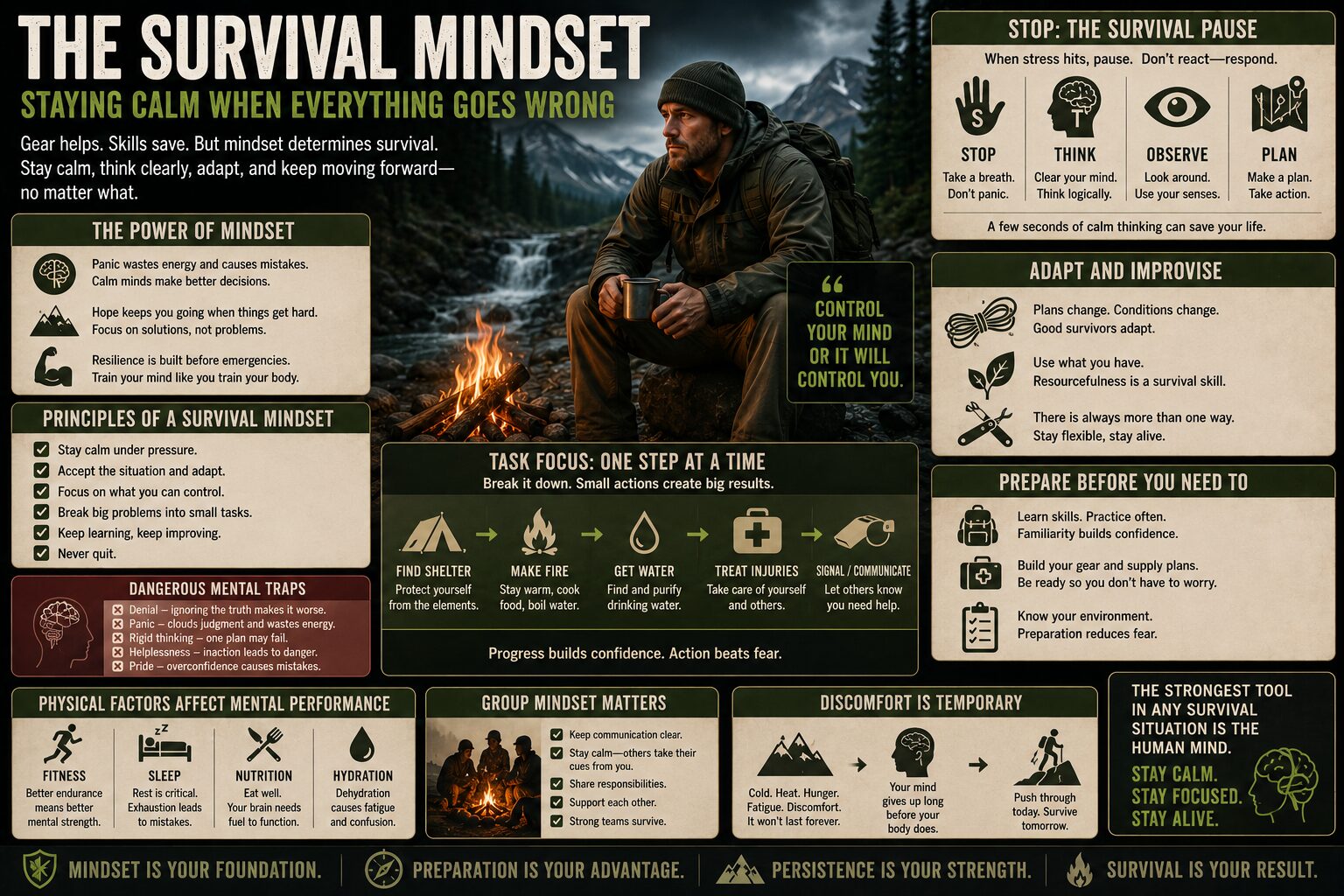
Survival instructors often teach the acronym STOP: Stop, Think, Observe, Plan.
It sounds simple, but it works because it interrupts panic before poor decisions take over. A lost hiker who immediately begins running through the woods may become more disoriented, exhausted, and difficult to locate. A person who pauses, calms down, and studies the environment often identifies solutions much faster.
Mental discipline becomes especially important because survival situations rarely unfold the way people expect. Movies portray emergencies as dramatic action scenes filled with constant excitement, but real survival often involves discomfort, uncertainty, waiting, and problem-solving under stress.
Cold, hunger, exhaustion, and fear slowly wear people down mentally. Small problems begin to feel overwhelming when combined together over time. This is why morale plays such a critical role in survival.
Hope matters.
A person who believes survival is possible continues looking for solutions. Someone who mentally gives up often stops making effective decisions entirely. Many survival stories throughout history reveal the same pattern: determination and adaptability frequently matter more than physical strength alone.
The survival mindset also requires flexibility. Nature does not care about plans. Weather changes unexpectedly. Equipment fails. Routes become blocked. Injuries happen. People who survive difficult situations usually adapt instead of becoming emotionally trapped by failed expectations.
Rigid thinking becomes dangerous in emergencies.
A person focused entirely on one specific plan may ignore better opportunities developing around them. Adaptability allows survivalists to use available resources creatively rather than obsessing over what they lack.
Improvisation is one of the core traits of experienced outdoorsmen. A tarp becomes shelter. Trash becomes insulation. A broken branch becomes a walking stick. Small resources gain enormous value when viewed through a survival mindset.
Training and repetition also help build mental resilience. People often assume courage appears naturally during emergencies, but confidence usually comes from familiarity and preparation. Practicing survival skills ahead of time reduces panic because actions become more automatic under stress.
Someone who has built fires repeatedly in bad weather stays calmer during a real emergency than someone attempting it for the first time while freezing cold and exhausted.
The same principle applies to navigation, first aid, shelter building, communication, and emergency planning. Practice creates familiarity, and familiarity reduces fear.
Physical fitness also affects survival psychology more than many people realize. Exhaustion weakens mental clarity rapidly. A tired person becomes more emotional, impatient, and prone to mistakes. Good physical conditioning improves endurance, mobility, and emotional control during stressful situations.
Sleep deprivation creates another major survival challenge. Lack of sleep impairs judgment almost as severely as alcohol intoxication in some cases. During prolonged emergencies, maintaining rest becomes critical for clear thinking and emotional stability.
One of the most dangerous mental traps in survival situations is denial.
People sometimes refuse to accept the seriousness of a situation because reality feels uncomfortable or frightening. Delayed evacuation during hurricanes, ignoring severe weather warnings, or underestimating injuries can all make emergencies far worse.
The survival mindset requires honest assessment of conditions even when the truth feels unpleasant.
At the same time, survivalists avoid catastrophizing unnecessarily. Calm realism works better than panic or denial. The goal is not fear. The goal is awareness and preparation.
Another important aspect of survival psychology is task focus. Large emergencies become mentally overwhelming when viewed as one massive problem. Experienced survivalists break situations into smaller manageable tasks instead.
Find shelter. Start a fire. Purify water. Signal for help. Treat injuries.
Completing small objectives restores a sense of control and momentum. Even simple tasks improve morale because action reduces helplessness.
Group survival introduces additional psychological challenges. Fear spreads quickly through groups, especially when communication breaks down. Strong leadership, calm communication, and clear responsibilities help maintain stability during crises.
People naturally look for emotional cues from others during emergencies. Calm individuals often influence entire groups positively, while panic can spread just as rapidly.
This is one reason preparedness matters so much before emergencies occur. Families with plans, supplies, and practiced routines usually respond more effectively because uncertainty decreases significantly.
The survival mindset also includes accepting discomfort.
Modern life conditions people to expect constant convenience. Air conditioning, instant communication, unlimited food, electricity, and comfortable shelter create dependence on stable systems. Emergencies disrupt those comforts quickly.
Preparedness-minded people intentionally learn skills that increase tolerance for discomfort. Camping, hiking, cold weather exposure, manual labor, and outdoor experience all strengthen resilience gradually. People who understand that discomfort is temporary often manage emergencies better emotionally.
Nature also teaches humility.
No amount of confidence changes weather, terrain, or physical limitations. Experienced outdoorsmen respect conditions instead of trying to overpower them recklessly. Humility encourages caution, preparation, and good judgment.
One fascinating aspect of survival psychology is how strongly attitude influences physical performance. Two people facing identical conditions may respond completely differently mentally. One focuses entirely on fear and discomfort, while the other concentrates on solutions and small victories.
Mindset changes behavior, and behavior changes outcomes.
This does not mean positive thinking magically solves emergencies. Real survival still depends on practical action and good decision-making. But mental resilience often determines whether people continue functioning effectively when conditions become difficult.
Preparedness ultimately builds confidence because it reduces uncertainty. Emergency food, backup water, medical supplies, communication plans, and survival skills all create psychological stability before disasters ever happen.
The goal of preparedness is not living in fear of catastrophe.
It is developing the confidence to handle adversity calmly if it arrives.
Because when systems fail, conditions worsen, and pressure rises, the most important survival tool will always be the human mind.