By Survival Boys Editorial Team
When people think about survival and preparedness, they often imagine wilderness survival, natural disasters, or large-scale emergencies. But for most families, the most important survival location is much closer to home. Your house is where your food, water, supplies, and loved ones are located. In nearly every crisis, home becomes the first and most important shelter.
That is why household security is one of the foundations of preparedness.
Good household security is not about fear or paranoia. It is about creating layers of protection that reduce risk, increase awareness, and improve safety during both normal situations and emergencies. Storms, power outages, break-ins, civil unrest, and natural disasters all place stress on families. A secure home provides stability when the outside world becomes unpredictable.

One of the biggest mistakes people make is assuming security only means locks or weapons. True household security is much broader. It includes awareness, lighting, communication, planning, structural protection, emergency preparation, and the habits developed long before anything goes wrong.
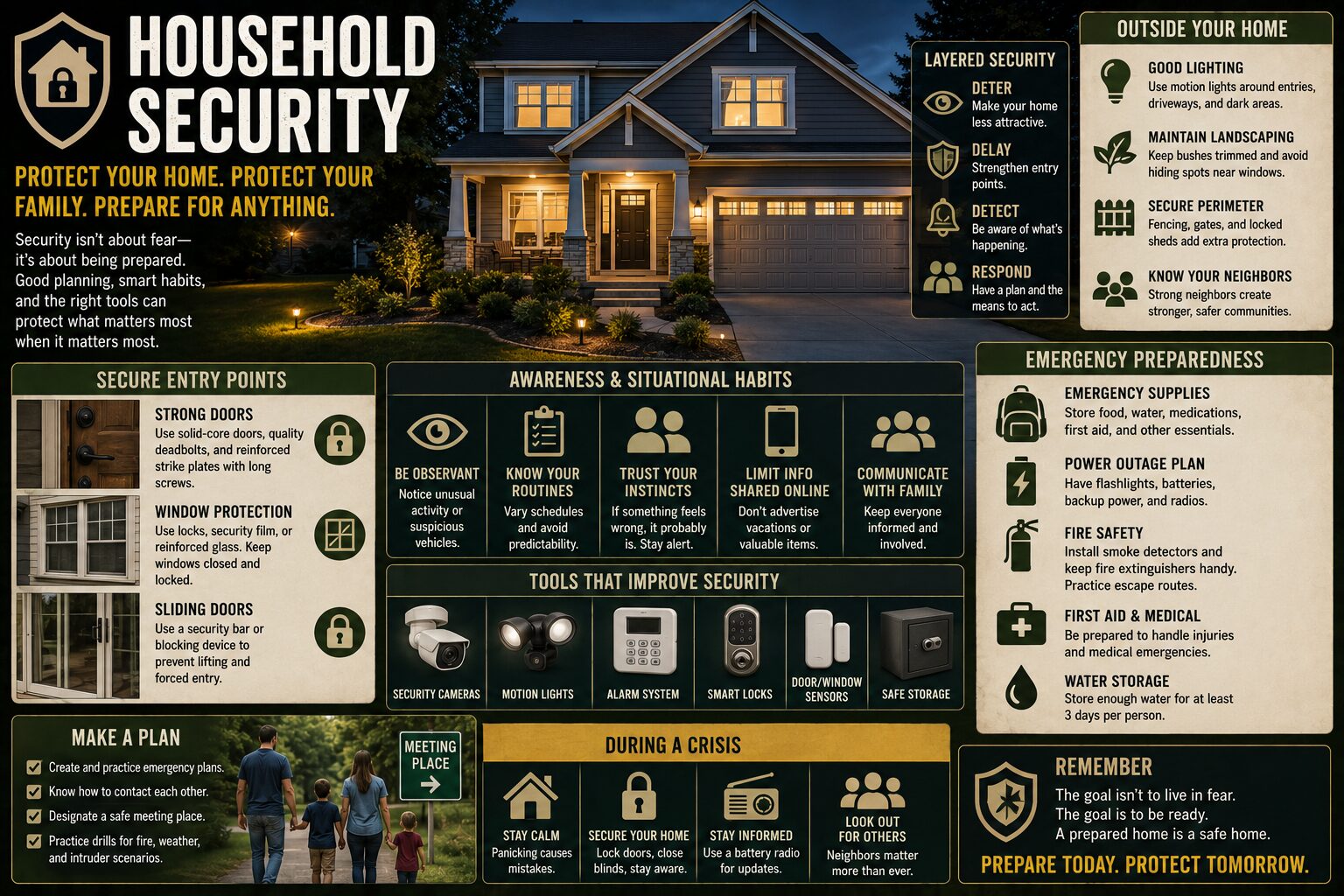
The first layer of home security begins outside the house itself. Criminals and intruders often look for easy targets. Homes with poor lighting, overgrown landscaping, hidden entry points, or obvious signs of neglect may appear more vulnerable than well-maintained properties.
Exterior lighting alone can dramatically improve security. Motion-activated lights around doors, driveways, backyards, and garages remove darkness that could otherwise conceal movement. Good lighting also improves visibility during emergencies such as power outages or severe weather.
Landscaping matters more than many people realize. Thick bushes directly beneath windows create hiding spots, while trees growing too close to roofs may provide access points. Keeping sightlines open around entryways improves visibility for both homeowners and neighbors.
Doors are one of the most critical security points in any home. Many break-ins happen through weak doors or poorly reinforced frames rather than sophisticated forced entry methods. A strong deadbolt means little if the surrounding door frame splinters under pressure.
Solid-core doors, reinforced strike plates, longer mounting screws, and quality locks significantly improve resistance against forced entry. Sliding glass doors often require additional reinforcement because they can be vulnerable to lifting or impact.
Windows are another common weak point. Window locks, security film, and reinforced glass improve protection without making the home feel like a fortress. Curtains and blinds also provide privacy that prevents outsiders from easily observing valuables, supplies, or household routines.
Preparedness-minded families often think carefully about visibility during emergencies. Large stockpiles of supplies visible through windows may attract unwanted attention during long-term crises. Maintaining a normal outward appearance can sometimes improve security more effectively than aggressive fortification.
One of the most powerful household security tools is simply awareness. Many emergencies provide warning signs before they escalate fully. Strange vehicles repeatedly driving through neighborhoods, suspicious behavior, damaged infrastructure, or rising local tensions may all indicate developing problems.
Paying attention to surroundings allows families to respond earlier instead of reacting at the last minute. Good situational awareness often prevents problems entirely.
Communication also plays a major role in household security. Family members should know how to contact one another during emergencies, where to meet if separated, and how to respond during different situations. Severe storms, fires, power outages, and evacuation orders can create confusion quickly if no plans exist ahead of time.
Emergency drills may feel unnecessary until real emergencies happen. Practicing fire escape routes, severe weather procedures, and communication plans helps reduce panic during high-stress situations. In emergencies, people rarely rise to the occasion. They usually fall back on their level of preparation.
Power outages are one of the most common household emergencies and often expose weaknesses in home security quickly. Darkness reduces visibility, electronic systems may fail, and communication becomes more difficult. Backup lighting, battery systems, flashlights, radios, and alternative cooking methods become extremely important during extended outages.
Generators provide valuable backup power, but they also create new security concerns. Noise and visible fuel storage may attract attention during widespread outages. Safe fuel storage and proper generator placement are essential both for security and fire prevention.
Fire safety itself remains one of the most overlooked aspects of household security. House fires spread rapidly, especially during electrical failures or heating emergencies. Smoke detectors, fire extinguishers, and escape plans save lives far more often than dramatic survival gear.
Preparedness means thinking beyond dramatic scenarios and focusing on realistic risks that families actually face.
Medical emergencies are another major part of household readiness. A well-stocked first aid kit, basic medical knowledge, and emergency contact information improve a family’s ability to respond during accidents or disasters when emergency services may be delayed.
Food and water storage also contribute directly to household security. Families who maintain emergency supplies are less vulnerable during storms, shortages, or infrastructure disruptions. Even short-term events can empty store shelves surprisingly fast.
Water becomes especially important because municipal systems may fail during hurricanes, freezes, earthquakes, or contamination events. Preparedness-minded households often store emergency water supplies and maintain backup purification methods.
Neighborhood relationships can become one of the strongest security assets during emergencies. Communities that communicate and cooperate often recover faster and respond more effectively than isolated households. Trusted neighbors can watch properties, share information, assist during evacuations, and provide mutual support when outside help is delayed.
Technology has also changed household security significantly in recent years. Cameras, smart locks, alarm systems, and remote monitoring provide homeowners with powerful tools for awareness and protection. However, technology should support security rather than replace personal preparedness entirely.
Electronic systems depend on electricity, internet access, and functioning infrastructure. Severe disasters may disable those systems unexpectedly. Redundancy remains important even in modern security planning.
Dogs continue to serve as one of the oldest and most effective home security tools. Even small dogs often provide early warning through barking and heightened awareness of unusual activity. Larger breeds may also act as deterrents simply through presence alone.
However, no security measure works perfectly alone. Household security functions best through layers. Lighting, strong doors, awareness, emergency supplies, communication plans, community relationships, and preparedness together create resilience far stronger than any single tool.
Mental readiness is another critical factor. Stress affects decision-making during emergencies. Panic causes mistakes, poor judgment, and delayed responses. Families who think through scenarios ahead of time often remain calmer and more effective when problems actually occur.
Children benefit greatly from preparedness education as well. Teaching basic emergency procedures, fire safety, communication plans, and awareness skills helps build confidence instead of fear. Preparedness should empower families, not terrify them.
One important aspect of household security is avoiding unnecessary attention during crises. During widespread emergencies, desperation may increase theft, conflict, or opportunistic crime. Maintaining operational security by avoiding public displays of supplies or resources can reduce unwanted risks significantly.
Preparedness-minded households often focus on self-reliance because outside help may not arrive quickly during large-scale emergencies. Police, firefighters, hospitals, and emergency responders can become overwhelmed during disasters. Families capable of remaining calm and independent place less strain on emergency systems while improving their own safety.
Still, household security is not about living in fear of worst-case scenarios. It is about understanding that emergencies happen regularly and preparation improves outcomes. Storms knock out power. Break-ins occur. Fires spread. Infrastructure fails. Preparedness simply reduces vulnerability when normal systems stop functioning temporarily.
The strongest households are not necessarily the most heavily fortified.
They are the most prepared, adaptable, and aware.
True household security comes from creating a home capable of protecting, supporting, and sustaining the people inside it when the unexpected happens.