By Survival Boys Editorial Team
In any survival situation, water quickly becomes the top priority. People can survive for weeks without food, but only a few days without clean drinking water. Dehydration weakens the body rapidly, affects decision-making, and reduces physical performance long before a person feels truly desperate. Even worse, drinking contaminated water can cause illness severe enough to become life-threatening when medical care is unavailable.
That is why water purification remains one of the most important survival skills anyone can learn.
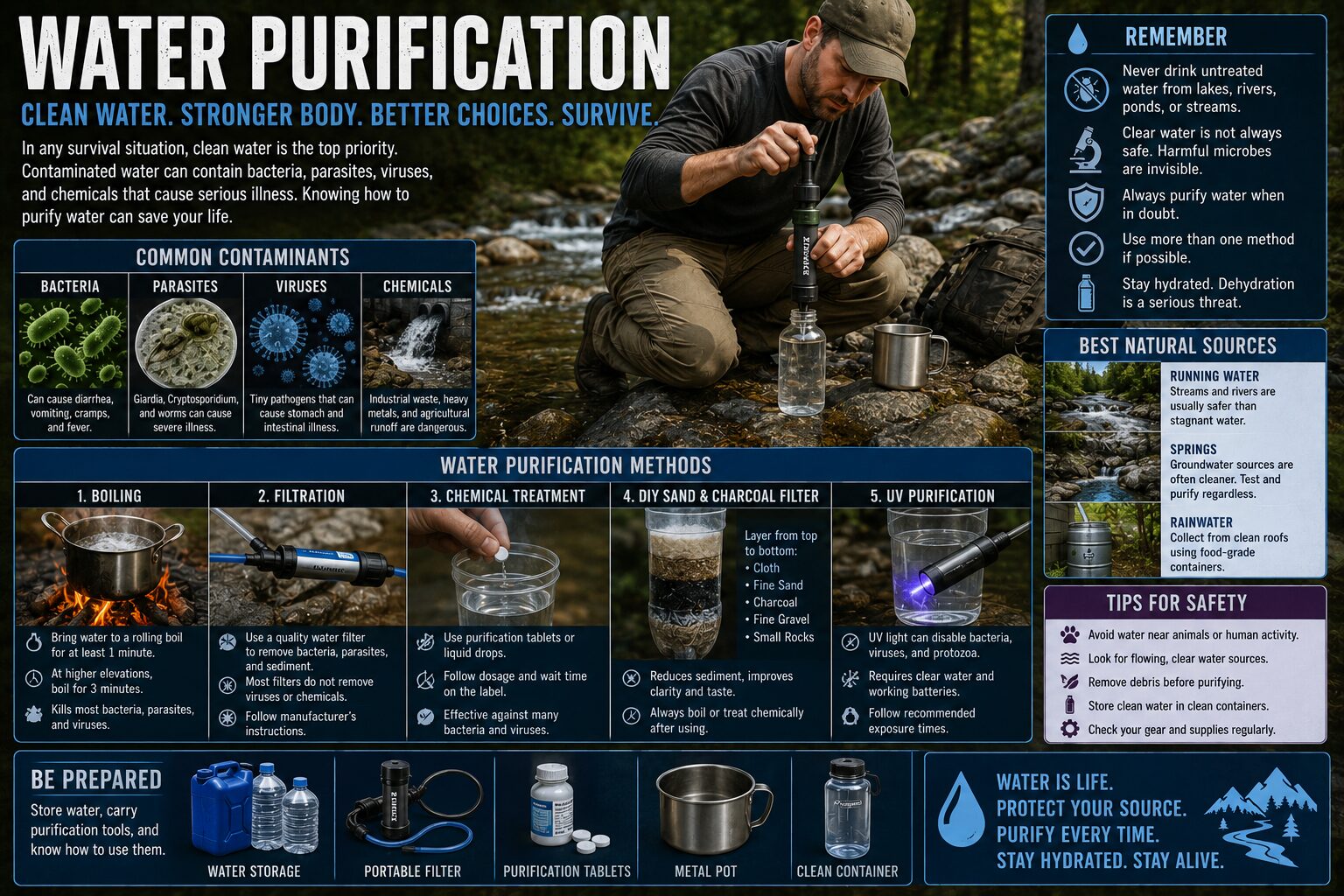
Many people assume clear water is safe to drink, but appearances can be dangerously misleading. Streams, lakes, ponds, and even mountain runoff may contain bacteria, parasites, viruses, chemicals, or microscopic contaminants invisible to the naked eye. A person stranded outdoors who drinks untreated water risks turning an already difficult situation into a medical emergency.

In wilderness survival, finding water is only the first step. Making it safe comes next.
Boiling is one of the oldest and most reliable purification methods in the world. Heat destroys most harmful microorganisms that commonly cause waterborne illness. When water reaches a rolling boil, dangerous bacteria and parasites are usually neutralized effectively. In survival situations, boiling remains highly trusted because it requires minimal equipment and works in nearly every environment.
The challenge with boiling is fuel consumption. Firewood, cooking fuel, or heat sources may become limited during emergencies, especially in wet or cold conditions. Boiling also does not remove chemical pollutants, heavy metals, or debris from the water itself. Muddy or dirty water should ideally be filtered before boiling to improve quality and reduce sediment.
Filtration systems provide another extremely popular purification method. Modern portable filters are lightweight, compact, and capable of removing many dangerous contaminants quickly. Backpackers, hikers, and survivalists often carry personal filtration systems because they allow fast access to drinking water during travel.
Most survival filters work by forcing water through microscopic pores that trap bacteria, parasites, and sediment. Some advanced systems also reduce chemical tastes and odors using activated carbon filters. However, not every filter removes viruses, which are much smaller than bacteria. Understanding the limitations of specific equipment is extremely important.
In preparedness circles, redundancy matters. Experienced outdoorsmen rarely depend entirely on a single purification method because equipment can fail unexpectedly. Filters clog, break, freeze, or become damaged under harsh conditions. Having backup purification options dramatically improves survival reliability.
Chemical purification methods offer another lightweight emergency solution. Water purification tablets and liquid treatments commonly use chlorine dioxide, iodine, or similar chemicals to kill harmful organisms. These products are widely used because they are compact, inexpensive, and easy to carry inside survival kits.
The downside is time. Chemical purification often requires waiting periods before water becomes safe to drink. Some methods also leave unpleasant tastes behind, while others become less effective against certain parasites or in extremely cold water. Even so, purification tablets remain valuable backups when boiling or filtration is unavailable.
One of the simplest emergency filtration methods involves creating layered filters from natural materials. Sand, charcoal, cloth, and gravel can help remove larger debris and improve water clarity. Primitive filters alone do not guarantee safe drinking water, but they can improve water quality before boiling or chemical treatment.
Charcoal plays an important role in many filtration systems because it absorbs some impurities and improves taste. Survivalists often create improvised charcoal filters using burned hardwood processed into fine carbon material. Combined with cloth and sand layers, this creates a basic field-expedient filtration setup.
Rainwater is often considered one of the safer emergency water sources because it begins as evaporated moisture rather than surface runoff. However, rainwater can still collect contaminants from roofs, containers, or polluted air. Clean collection systems and storage containers improve safety significantly.
In urban survival situations, water contamination risks may increase dramatically after disasters. Floodwaters often contain sewage, chemicals, fuel, and dangerous debris. Broken water systems may allow bacteria to spread rapidly through damaged infrastructure. During emergencies like hurricanes, earthquakes, or grid failures, public water supplies cannot always be trusted immediately.
This is why many preparedness-minded families store emergency water supplies before disasters occur. Water storage removes uncertainty during the critical early stages of emergencies when public systems may fail or become overwhelmed.
Stored water should always be kept in food-grade containers designed for long-term storage. Cool, dark storage locations help maintain water quality over time. Some people rotate stored water regularly, while others use preservatives specifically designed for long-term emergency supplies.
Survival experts often recommend having multiple water sources whenever possible. Wells, rain collection systems, nearby streams, stored water, and filtration equipment together create stronger resilience than relying on a single option alone.
One of the most overlooked dangers in survival situations is dehydration caused by poor decision-making. Fear, exhaustion, heat, and stress may push people to ration water too aggressively or drink from unsafe sources impulsively. Severe dehydration impairs judgment, making survival decisions progressively worse over time.
Hot climates increase water demand rapidly. A person hiking through desert terrain or working under intense heat may lose large amounts of water through sweat within hours. Electrolyte loss also becomes dangerous during prolonged exertion because the body depends on minerals like sodium and potassium for muscle and nerve function.
Cold environments create different challenges because people often underestimate dehydration risk in freezing conditions. Dry winter air and physical exertion still cause fluid loss even when thirst feels reduced. Snow and ice may appear abundant, but consuming unmelted snow lowers body temperature dangerously and accelerates hypothermia.
Experienced survivalists pay close attention to hydration long before thirst becomes severe. Dark urine, dizziness, fatigue, headaches, and confusion are common signs that dehydration is already affecting the body.
Water purification also becomes important for long-term homesteading and off-grid living. Wells, rain catchment systems, ponds, and natural springs all require monitoring and treatment to ensure safety over time. Many self-reliant households install multi-stage filtration systems capable of supporting daily use during both normal conditions and emergencies.
Modern preparedness often focuses heavily on gear, but water purification teaches a deeper survival principle: knowledge matters more than equipment alone. A person who understands how contamination spreads, how purification works, and how to identify safer water sources possesses valuable survival advantages even with limited tools.
Water shapes nearly every aspect of survival. It affects cooking, sanitation, health, agriculture, hygiene, and physical endurance. Without reliable clean water, even the best food supplies and survival equipment become far less valuable.
That is why experienced outdoorsmen often say survival begins with water.
Not because water is convenient.
But because without it, nothing else matters for very long.