
By Survival Boys Editorial Team
In a world where food prices continue to rise and supply chains remain vulnerable to disruption, more people are looking for sustainable ways to grow food at home. Gardening has always been one of the foundations of self-reliance, but modern technology has created new methods capable of producing large amounts of food in surprisingly small spaces.
One of the most fascinating and efficient systems is aquaponics.
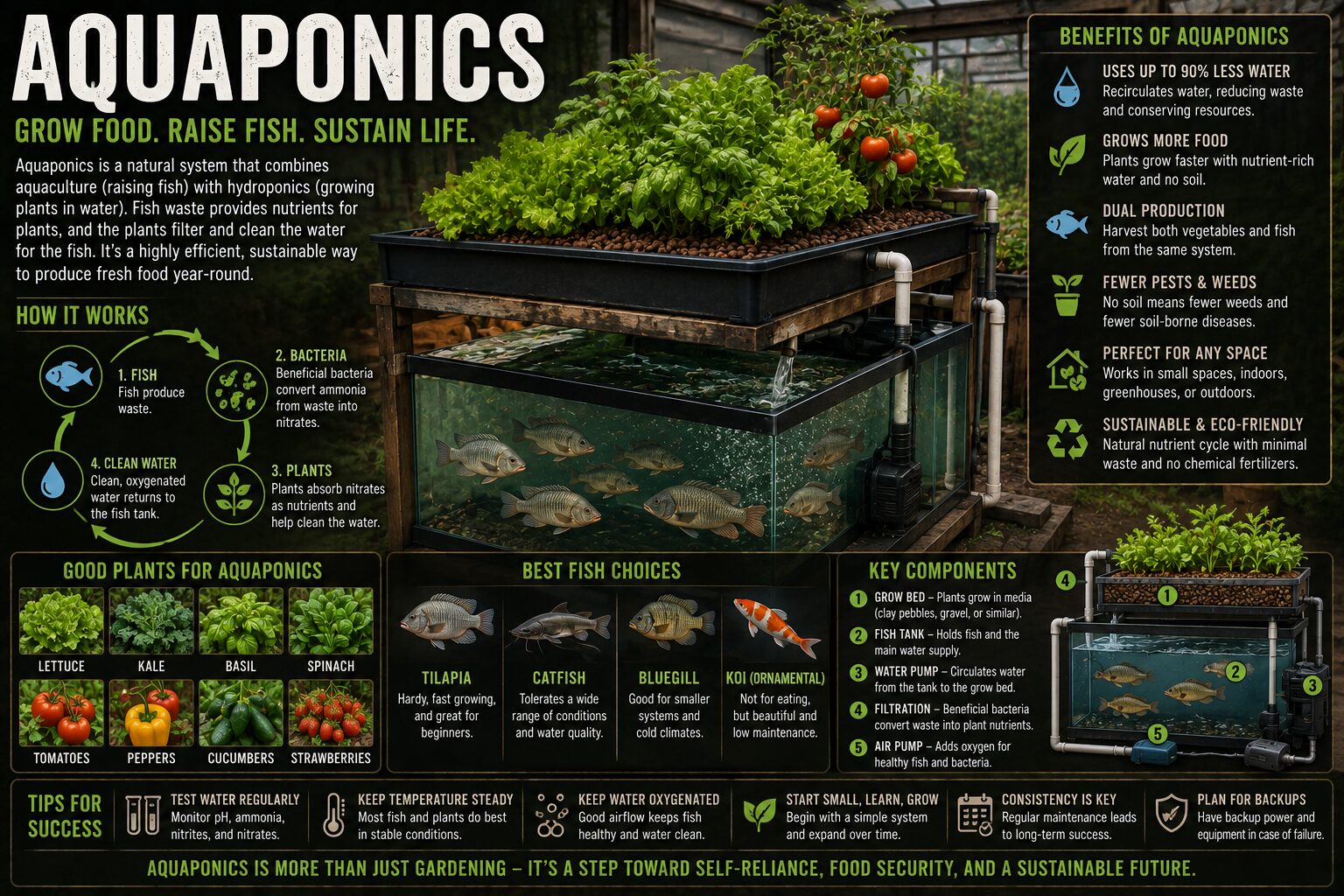
Aquaponics combines fish farming and hydroponic gardening into a single ecosystem where plants and fish work together to support one another. Instead of growing crops in traditional soil, plants grow in water enriched by nutrients produced from fish waste. The plants naturally filter the water, which is then recirculated back to the fish tank.

The result is a highly efficient food production system that can grow vegetables and protein simultaneously while using far less water than traditional farming.
For preparedness-minded families, off-grid homesteaders, and survival enthusiasts, aquaponics offers something incredibly valuable: the ability to produce food consistently in limited space with minimal waste.
The concept behind aquaponics may sound complicated at first, but the natural process itself is surprisingly simple. Fish produce waste as they live and feed inside a tank. That waste creates ammonia in the water. In large amounts, ammonia becomes toxic to fish, but beneficial bacteria naturally convert the ammonia into nitrites and then into nitrates. Those nitrates become nutrient-rich fertilizer for plants.
The plants absorb the nutrients through their roots, cleaning the water in the process before it cycles back into the fish tank.
This creates a living ecosystem where each part supports the others.
Nature already works this way in lakes, ponds, and rivers. Aquaponics simply recreates the process in a controlled environment designed for food production.
One of the biggest advantages of aquaponics is water efficiency. Traditional farming uses enormous amounts of water because much of it evaporates or drains away into the soil. In aquaponic systems, water continuously recirculates. The same water may remain in use for long periods with only occasional replacement due to evaporation or plant absorption.
In drought-prone regions or emergency preparedness situations where water conservation matters, this efficiency becomes extremely important.
Aquaponic systems also allow food production in places where normal gardening may struggle. Rocky soil, poor ground conditions, urban environments, and limited land become far less restrictive when crops grow in controlled water systems instead of traditional dirt gardens.
Many people begin with small backyard systems consisting of a fish tank, water pump, and grow beds filled with clay pebbles or similar growing media. Water circulates from the fish tank into the grow bed, where plant roots absorb nutrients before the filtered water drains back into the tank.
More advanced systems may include vertical growing towers, greenhouse environments, solar-powered pumps, automated monitoring systems, and large-scale food production setups.
The choice of fish plays a major role in the success. Some species tolerate changing water conditions better than others. Tilapia are among the most popular choices because they grow quickly, adapt well to crowded conditions, and tolerate warmer water temperatures. Catfish, bluegill, perch, and koi are also common in different systems, depending on climate and goals.
Some people use aquaponics strictly for vegetable production and keep ornamental fish instead of edible species. Others focus heavily on producing both vegetables and protein simultaneously for long-term food independence.
The plants chosen for aquaponics also matter. Leafy greens tend to perform especially well because they absorb nutrients efficiently and grow quickly. Lettuce, kale, spinach, basil, and herbs are commonly grown in aquaponic systems. Tomatoes, peppers, cucumbers, and strawberries can also thrive under the right conditions, though larger fruiting plants often require additional nutrient management.
One of the reasons aquaponics attracts survivalists and homesteaders is its productivity. A relatively small area can produce a surprising amount of food year-round when managed properly. Greenhouse systems extend growing seasons significantly, while indoor systems with artificial lighting may produce food regardless of outdoor weather conditions.
This level of food control becomes appealing during uncertain times.
Natural disasters, economic instability, fuel shortages, or supply chain disruptions can quickly affect grocery stores. An aquaponic system offers a level of food resilience that traditional dependence on supermarkets cannot provide.
However, aquaponics is not effortless. The system depends heavily on balance. Water chemistry, fish health, bacteria growth, temperature, oxygen levels, and nutrient cycling all interact with each other. Problems in one area can affect the entire system quickly.
New systems require time to establish beneficial bacterial colonies before fish and plants fully thrive. This process, known as cycling, is one of the most important early stages in aquaponics development. Without healthy bacterial populations, ammonia may rise to dangerous levels and harm fish.
Water quality monitoring becomes a regular part of aquaponics management. Parameters like pH, ammonia, nitrites, nitrates, and water temperature all influence system health. Serious aquaponic growers often use testing kits to track conditions and make adjustments before problems become severe.
Electricity is another important consideration. Most aquaponic systems rely on pumps to circulate water and aerate fish tanks. Without water movement, oxygen levels may drop rapidly, threatening fish survival. In preparedness situations, backup power systems become extremely valuable.
Many survival-focused aquaponic setups incorporate solar panels, battery banks, or backup generators to maintain water circulation during outages. Redundancy matters because system failures can escalate quickly if left unattended.
Despite these challenges, aquaponics offers several major advantages compared to traditional agriculture. Weeds become far less of a problem because plants are not growing in soil. Many soil-borne diseases disappear entirely. Water efficiency remains extremely high, and nutrient recycling reduces fertilizer dependence significantly.
Another major advantage is reduced physical strain. Raised grow beds and vertical systems make gardening more accessible for people with mobility limitations or limited space. Urban dwellers can build productive systems in garages, greenhouses, patios, or even spare rooms.
Aquaponics also appeals to people interested in sustainable living. Traditional agriculture often relies heavily on synthetic fertilizers, pesticides, and large-scale water consumption. Aquaponics creates a more closed-loop ecosystem where waste becomes a resource instead of a problem.
For children and families, aquaponics can become an incredible educational tool as well. Watching fish, plants, bacteria, and water cycles work together teaches biology, ecology, chemistry, and food production in a hands-on way that books alone rarely accomplish.
In survival situations, food production systems capable of functioning independently become extremely valuable. Stored food eventually runs out. Gardens may fail due to drought or poor soil conditions. Aquaponics offers an additional layer of food security through controlled production and efficient resource use.
Some advanced homesteaders even combine aquaponics with other systems to create integrated survival setups. Solar energy powers pumps. Rainwater collection feeds the tanks. Compost supports supplemental gardening. Greenhouses regulate temperatures. Chickens provide additional food and fertilizer resources nearby.
The result becomes a partially self-sustaining ecosystem designed for resilience.
Still, aquaponics should not be viewed as a magical solution. It requires learning, maintenance, observation, and patience. Fish can become sick. Pumps can fail. Water chemistry can shift unexpectedly. Beginners often face setbacks while learning how to maintain balance within the system.
But like many survival skills, aquaponics rewards experience over time. Small systems teach valuable lessons before larger expansions occur. Every challenge improves understanding of how living systems interact.
Perhaps the most fascinating aspect of aquaponics is how closely it mirrors natural survival principles. Nature wastes very little. In healthy ecosystems, outputs from one organism become resources for another. Aquaponics simply harnesses those relationships for human food production.
As interest in preparedness, sustainability, and self-reliance continues growing, aquaponics is becoming far more than a niche gardening method. It represents a modern approach to one of humanity’s oldest priorities: producing reliable food.
In uncertain times, the ability to grow vegetables and raise protein within a controlled ecosystem may become one of the most valuable forms of independence a family can develop.
Because true preparedness is not only about storing resources.
It is also about learning how to produce them.