
By Survival Boys Editorial Team
For most people, asteroid impacts belong in science fiction movies — giant fireballs streaking across the sky while cities collapse in chaos. But asteroid and meteor strikes are real events that have shaped Earth’s history for billions of years. While a civilization-ending asteroid is extremely rare, smaller impacts happen more often than most people realize.
In 2013, a meteor exploded over Chelyabinsk, Russia, with the force of a nuclear blast. The shockwave shattered windows across the city and injured more than 1,500 people. That was caused by a space rock only about 60 feet wide.
The truth is simple: if a major impact ever occurred near a populated area, survival would depend heavily on preparation, fast decisions, and understanding the dangers ahead.

This guide covers what happens during a meteor or asteroid strike, how to prepare before one happens, and what to do during the critical hours and days afterward.
Meteor vs. Asteroid: What’s the Difference?
People often use these words interchangeably, but they mean different things.
- Asteroid – A rocky object orbiting the sun, usually found in space.
- Meteor – A space rock entering Earth’s atmosphere.
- Meteorite – Any part of the object that survives impact and reaches the ground.
Most meteors burn up harmlessly in the atmosphere. The danger comes from larger objects capable of creating blast waves, fires, earthquakes, or massive debris fields.
How Dangerous Could an Impact Be?
The effects depend on several factors:
- Size of the object
- Speed
- Composition
- Angle of impact
- Location of impact
A small meteor might create a bright fireball and sonic boom.
A larger asteroid could flatten cities, ignite fires for miles, and disrupt communications and infrastructure.
An ocean impact could trigger tsunamis affecting coastal regions hundreds of miles away.
A truly massive impact could alter global climate conditions for years through dust and smoke blocking sunlight.
Fortunately, extinction-level events are incredibly rare. Still, regional disasters are possible enough that preparedness matters.
Warning Signs Before an Impact
Unlike tornadoes or hurricanes, asteroid strikes may come with limited warning.
Possible alerts include:
- Government emergency broadcasts
- Wireless emergency alerts
- News reports from observatories or space agencies
- Reports of unusual fireballs or sonic booms
- Sudden evacuation orders
Organizations like NASA Planetary Defense Coordination Office constantly monitor near-Earth objects.
Some impacts might be predicted days or weeks ahead. Others could arrive with almost no notice.
That’s why having a preparedness plan before an emergency matters so much.
Immediate Dangers During an Impact
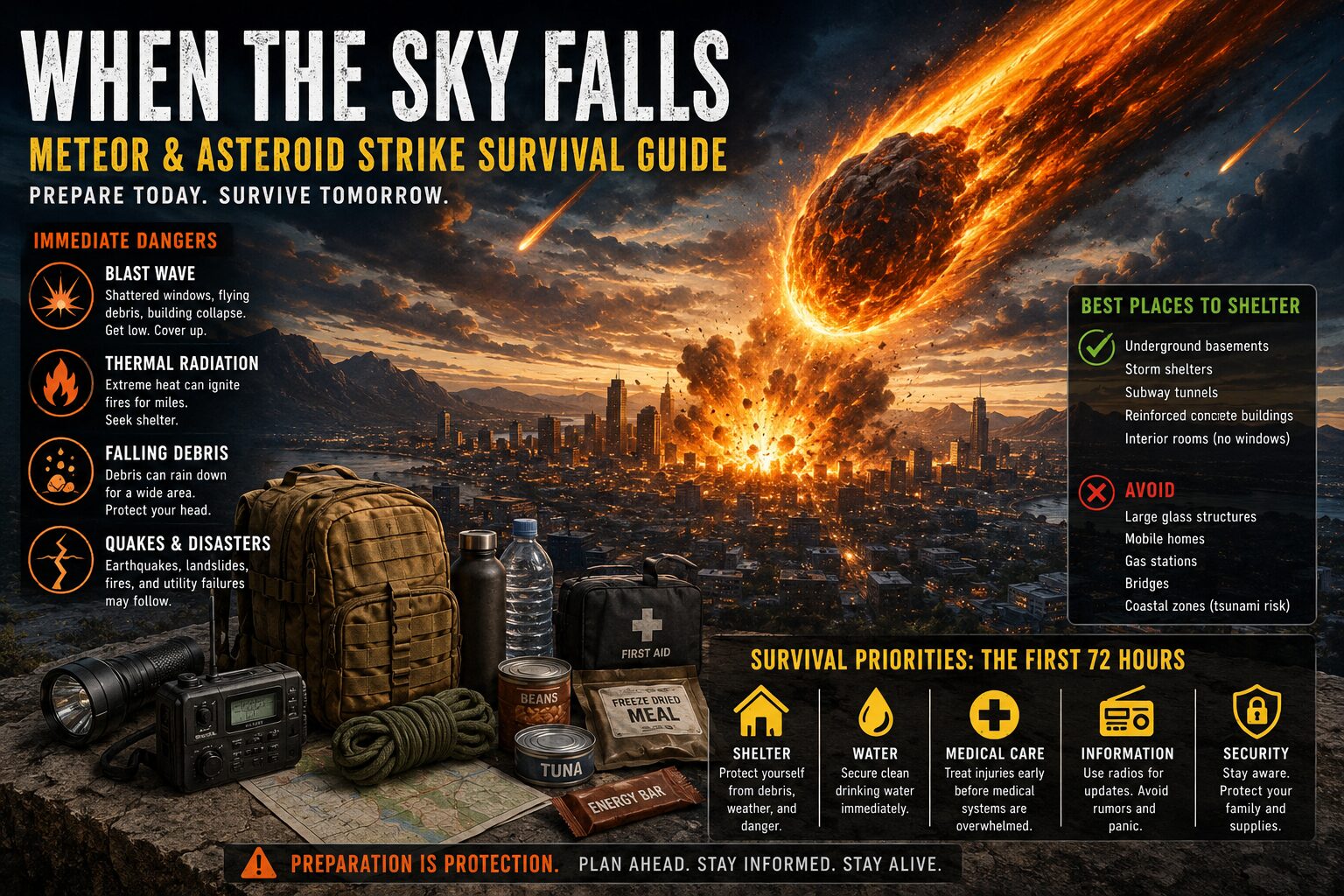
1. Blast Wave
The shockwave from an airburst or impact can travel for miles.
Windows shatter instantly. Buildings may partially collapse. Flying debris becomes deadly.
If you see an intense flash:
- Do NOT stand near windows
- Get low immediately
- Cover your head and neck
- Move toward interior rooms or a reinforced shelter
The shockwave may arrive several seconds after the flash, depending on the distance.
2. Thermal Radiation
Larger impacts may generate extreme heat capable of igniting fires.
Clothing, dry vegetation, and structures could catch fire quickly.
Protect yourself by:
- Staying indoors
- Avoiding exposure to open sky
- Covering exposed skin
- Moving underground if possible
3. Falling Debris
Debris can rain down over a wide area.
This may include:
- Broken glass
- Structural material
- Trees and power lines
- Meteor fragments
A helmet, heavy jacket, gloves, and eye protection can significantly reduce injuries.
4. Earthquakes and Secondary Disasters
Large impacts may trigger:
- Earthquakes
- Landslides
- Fires
- Utility failures
- Hazardous material leaks
Urban areas become especially dangerous due to collapsing infrastructure.
Best Places to Shelter
Your survival odds improve dramatically with proper shelter.
Ideal Shelter Locations
- Underground basements
- Storm shelters
- Subway tunnels
- Reinforced concrete buildings
- Interior rooms without windows
Avoid:
- Large glass structures
- Mobile homes
- Gas stations
- Bridges
- Coastal zones after ocean impacts
If you live in a hurricane-prone area, many of the same reinforced shelter principles apply here as well.
Essential Emergency Supplies
A meteor strike could knock out power grids, communications, and transportation for days or weeks.
Your emergency supplies should include:
Water
Store at least:
- 1 gallon per person per day
- Minimum 2-week supply if possible
Water filtration systems are also critical.
Food
Focus on:
- Freeze-dried meals
- Canned foods
- Rice and beans
- High-calorie emergency bars
Choose foods requiring minimal cooking.
Medical Supplies
Your kit should contain:
- Trauma supplies
- Bandages
- Burn treatment
- Pain relievers
- Prescription medications
- N95 masks
Dust and smoke may become serious respiratory hazards after impacts.
Power and Lighting
Have:
- Solar chargers
- Flashlights
- Hand-crank radios
- Backup batteries
Electronics may fail if the infrastructure is heavily damaged.
Protecting Your Family
In a fast-moving disaster, confusion kills.
Every family should establish:
- Meeting points
- Emergency contacts
- Evacuation routes
- Communication plans
Children should know:
- Where supplies are stored
- How to call for help
- Basic first aid
- Shelter procedures
Practice emergency drills occasionally so panic doesn’t take over during a real event.
Vehicle Survival During an Impact
If you are driving and witness a bright atmospheric explosion:
- Pull over immediately
- Stay away from overpasses
- Avoid stopping near trees or power lines
- Cover your face and head
- Remain low inside the vehicle
After the shockwave:
- Leave damaged vehicles if unsafe
- Watch for fires
- Avoid downed power lines
- Listen to emergency broadcasts
Roads may become blocked quickly.
Surviving the First 72 Hours
The first three days after a major impact would likely be chaotic.
Expect:
- Cell service disruptions
- Panic buying
- Fuel shortages
- Medical overload
- Traffic gridlock
Your priorities should be:
1. Shelter
Stay protected from debris, weather, and civil unrest.
2. Water
Secure clean drinking water immediately.
3. Medical Care
Treat injuries early before hospitals become overwhelmed.
4. Information
Use battery or hand-crank radios for updates.
5. Security
Desperate situations can lead to crime and panic.
Stay aware of your surroundings.
Long-Term Survival Concerns
A significant impact could create longer-term challenges.
Food Supply Disruptions
Transportation networks may fail.
Store:
- Shelf-stable food
- Seeds
- Cooking fuel
- Water purification supplies
Air Quality Problems
Dust and smoke could linger for weeks.
Use:
- Respirators
- Sealed shelter areas
- Air filtration if available
Economic Collapse
Supply chains might break down temporarily.
Cash, barter items, and essential tools become valuable quickly.
Rural vs. Urban Survival
Urban Areas
Advantages:
- More shelters
- Better hospitals
- Faster emergency response
Disadvantages:
- Higher population density
- More panic
- Greater infrastructure damage
Rural Areas
Advantages:
- Lower population
- More self-sufficiency potential
- Easier resource gathering
Disadvantages:
- Limited medical access
- Slower aid response
- Isolation risks
Neither environment is perfect. Preparedness matters more than location alone.
Psychological Survival Matters Too
Large-scale disasters create emotional shock.
Fear, confusion, and panic can impair judgment.
Maintain structure by:
- Keeping routines
- Assigning tasks
- Staying informed
- Avoiding rumor-driven panic
Strong leadership and calm decision-making often determine survival outcomes.
Could Humanity Survive a Large Asteroid?
Yes — depending on the size.
Modern tracking systems improve detection every year, and scientists continue developing planetary defense strategies.
Programs involving organizations like NASA and the European Space Agency work to identify dangerous near-Earth objects before they become threats.
In 2022, NASA successfully altered an asteroid’s orbit during the DART mission, proving that asteroid deflection may be possible in the future.
Preparedness on both global and personal levels remains essential.
Final Thoughts
A meteor or asteroid strike may sound unlikely, but preparedness is about planning for low-probability, high-impact events.
The same supplies and survival skills useful during hurricanes, earthquakes, blackouts, and civil emergencies also help during an impact disaster.
Prepared people react faster, think more clearly, and recover more effectively.
You don’t need a bunker beneath a mountain to improve your odds.
You need:
- A plan
- Emergency supplies
- Reliable information
- The mindset to stay calm under pressure
When disaster strikes from above, preparation on the ground can make all the difference.