When people think about survival food, they usually imagine canned goods, hunting, fishing, or massive gardens. But there’s another system that combines all of those ideas into one powerful setup:
Aquaponics.
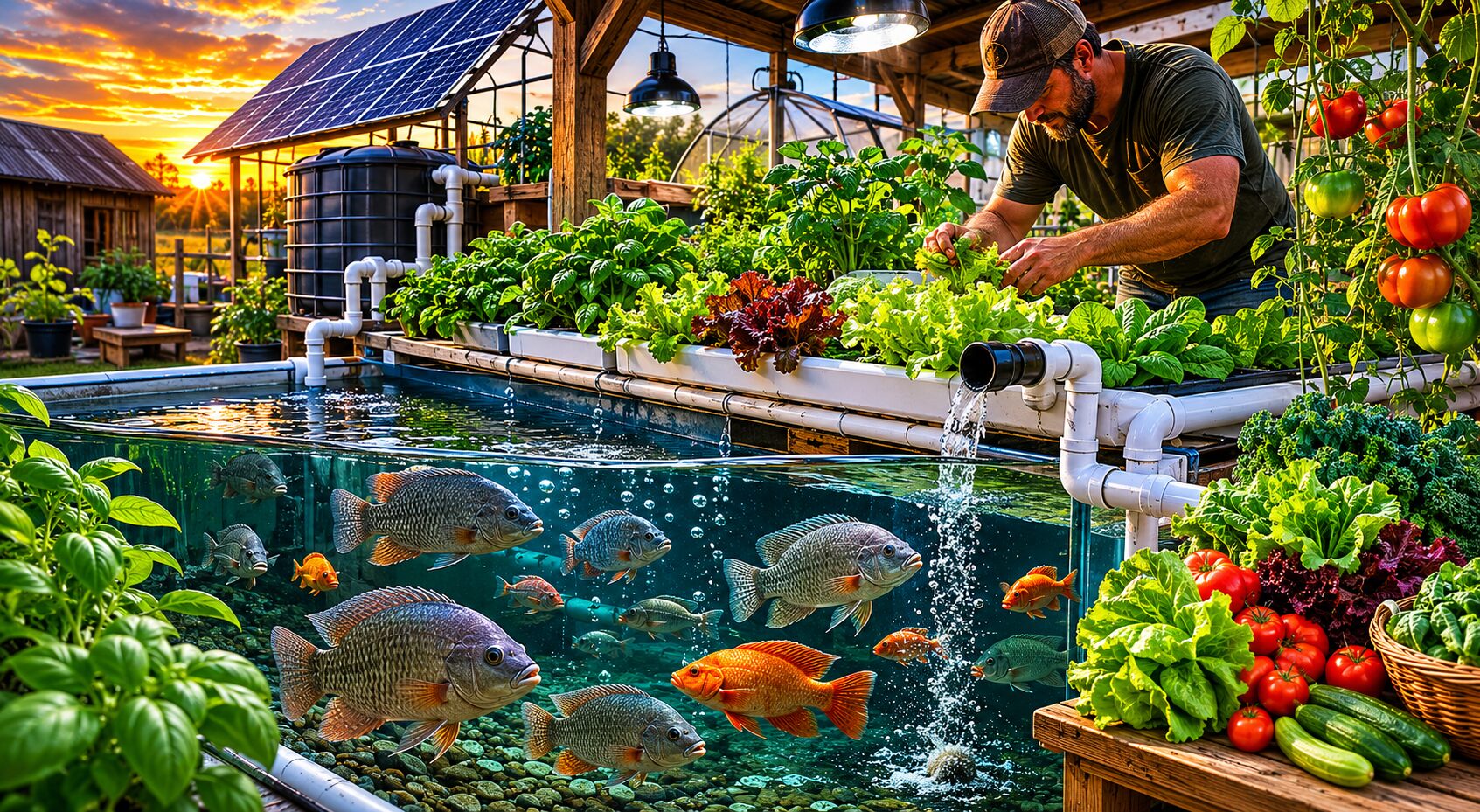
Aquaponics is a self-sustaining method of raising fish and growing plants together in a closed-loop system. The fish provide nutrients for the plants, and the plants help clean the water for the fish.
Done correctly, an aquaponics system can produce:

- Fresh vegetables year-round
- A renewable protein source
- Reduced water usage
- Food in small spaces
- Long-term sustainability during emergencies
For preppers, off-grid homesteaders, and survivalists, aquaponics is one of the most efficient ways to produce food after supply chains collapse.
What Is Aquaponics?
Aquaponics combines:
- Aquaculture — raising fish
- Hydroponics — growing plants in water
Instead of soil, plants grow in nutrient-rich water supplied by fish waste.
Here’s how it works:
- Fish produce waste.
- Beneficial bacteria convert that waste into plant nutrients.
- Plants absorb the nutrients.
- Clean water cycles back to the fish tank.
It’s a living ecosystem.
Once balanced, the system becomes highly efficient and surprisingly productive.
Why Aquaponics Matters in a Survival Situation
In a collapse scenario, traditional gardening has problems:
- Drought
- Poor soil
- Pests
- Seasonal limitations
- Fertilizer shortages
Aquaponics solves many of these issues.
Massive Water Savings
Traditional gardening uses huge amounts of water.
Aquaponics can use up to 90% less water because the system continuously recirculates it instead of losing it into the ground.
That matters during:
- Droughts
- Grid-down emergencies
- Water restrictions
- Off-grid living
Grow Food in Small Spaces
You don’t need acres of land.
Aquaponics systems can work:
- In backyards
- Garages
- Greenhouses
- Basements
- Shipping containers
- Small homesteads
Even urban survivalists can build compact food systems capable of producing real calories.
Produces Protein AND Vegetables
Most gardens only produce vegetables.
Aquaponics gives you:
- Fish for protein
- Vegetables for nutrients
That combination is incredibly valuable in long-term emergencies.
Protein becomes difficult to obtain after store shelves empty.
Fish can reproduce and provide continuous food if managed correctly.
Faster Plant Growth
Plants often grow faster in aquaponics because nutrients are delivered directly to the roots.
Many growers report:
- Faster harvest cycles
- Larger yields
- Less plant stress
In survival situations, speed matters.
Best Fish for Survival Aquaponics
Not every fish works well.
You need species that:
- Grow quickly
- Handle poor conditions
- Reproduce easily
- Resist disease
Here are the top survival choices.
Tilapia
Tilapia
Tilapia are the king of aquaponics.
Why?
- Fast-growing
- Hardy
- Easy to breed
- Tolerate crowded tanks
- Omnivores
The downside:
They prefer warm water.
Cold climates may require heating systems.
Catfish
Catfish
Catfish are excellent survival fish because they:
- Handle dirty water well
- Grow large
- Taste good
- Survive in difficult conditions
They’re ideal for southern climates and outdoor systems.
Bluegill
Bluegill
Bluegill are hardy and easy to maintain.
Advantages:
- Cold tolerant
- Good breeding potential
- Lower oxygen requirements
Not as fast-growing as tilapia, but easier for beginners.
Carp
Common Carp
Carp are survival tanks.
They:
- Survive poor water conditions
- Eat almost anything
- Reproduce aggressively
Not everyone enjoys eating them, but they’re extremely reliable.
Best Plants for Survival Aquaponics
Some plants thrive in aquaponics better than others.
Easy Starter Crops
- Lettuce
- Kale
- Spinach
- Basil
- Mint
- Swiss chard
These grow quickly and require fewer nutrients.
Heavy-Producing Crops
- Tomatoes
- Peppers
- Cucumbers
- Beans
- Peas
These need mature systems with higher nutrient levels.
Survival Calorie Crops
Many people overlook calorie production.
Good survival options include:
- Sweet potatoes
- Strawberries
- Dwarf beans
- Watercress
Aquaponics excels at greens, but calories still matter.
A balanced survival plan should include:
- Aquaponics
- Traditional gardening
- Food storage
- Livestock if possible
Types of Aquaponics Systems
Media Bed Systems
The simplest option.
Plants grow in gravel or clay pellets.
Pros:
- Beginner friendly
- Cheap
- Natural filtration
- Easy maintenance
Best for:
- Small homesteads
- First-time builders
Deep Water Culture (DWC)
Plants float on rafts above water.
Pros:
- High production
- Commercial efficiency
- Excellent for leafy greens
Cons:
- More complex
- Requires good oxygenation
NFT Systems
NFT stands for Nutrient Film Technique.
Water flows through pipes holding plant roots.
Pros:
- Lightweight
- Space efficient
- Fast growth
Cons:
- Roots can clog
- Vulnerable to pump failures
Not ideal for beginners.
The Biggest Weakness of Aquaponics
Aquaponics sounds perfect…
But it has vulnerabilities.
Electricity Dependence
Most systems rely on:
- Water pumps
- Air pumps
- Filtration systems
Without power:
- Oxygen drops
- Fish die
- Water stagnates
That means survival aquaponics MUST include backup systems.
Off-Grid Power Solutions
To make aquaponics truly survival-ready, consider:
- Solar panels
- Battery backups
- Manual aeration
- Gravity-fed systems
- DC water pumps
A simple solar setup can keep small systems alive indefinitely.
Water Quality Is Everything
Fish die fast in poor water.
You must monitor:
- pH
- Ammonia
- Nitrites
- Oxygen
- Water temperature
The system becomes easier over time, but beginners often lose fish by ignoring water chemistry.
Can Aquaponics Feed a Family?
Yes — but only if designed correctly.
A tiny countertop setup won’t feed four people after a collapse.
Real food production requires:
- Large fish tanks
- Multiple grow beds
- Reliable power
- Water reserves
- Fish breeding capability
Aquaponics should be part of a larger preparedness strategy.
Think of it as:
- A renewable food source
- A supplement to stored food
- A year-round food producer
Not a magic solution.
Essential Survival Aquaponics Supplies
If you want to start now, focus on:
- Food-grade fish tanks
- Grow beds
- Water pumps
- Air pumps
- Solar backup
- Water test kits
- Fish food
- Backup seeds
- Plumbing parts
- Water storage
Stock spare parts early.
After a major disaster, replacement pumps may be impossible to find.
Beginner Mistakes to Avoid
Adding Too Many Fish
Overcrowding causes:
- Ammonia spikes
- Oxygen loss
- Fish deaths
Start slow.
Ignoring Backup Power
One power outage can wipe out months of work.
Always have redundancy.
Starting Too Large
Build small first.
Learn the system before scaling up.
Poor Fish Choices
Choose fish suited for your climate.
Heating water during winter may become impossible during grid failure.
The Best Survival Setup
For most people, the ideal survival aquaponics system is:
- Medium-sized
- Solar-powered
- Gravity-assisted
- Greenhouse protected
- Combined with traditional gardening
That creates:
- Redundancy
- Diversity
- Reliability
Exactly what survival planning requires.
Final Thoughts
Aquaponics is not just a gardening trend.
It’s one of the most efficient long-term food production systems available for preparedness-minded people.
It combines:
- Water conservation
- Protein production
- Vegetable growing
- Small-space efficiency
- Sustainable food cycles
In a world where supply chains can fail overnight, the ability to grow both fish and vegetables at home is a massive advantage.
The best time to learn aquaponics is before you need it.
Because once grocery stores empty…
Learning by trial and error may no longer be an option.