Most people think of a power outage as a lighting problem.
The lights go out. The television stops working. Maybe the Wi-Fi disappears.
But inside your home, something much more important may also be happening.
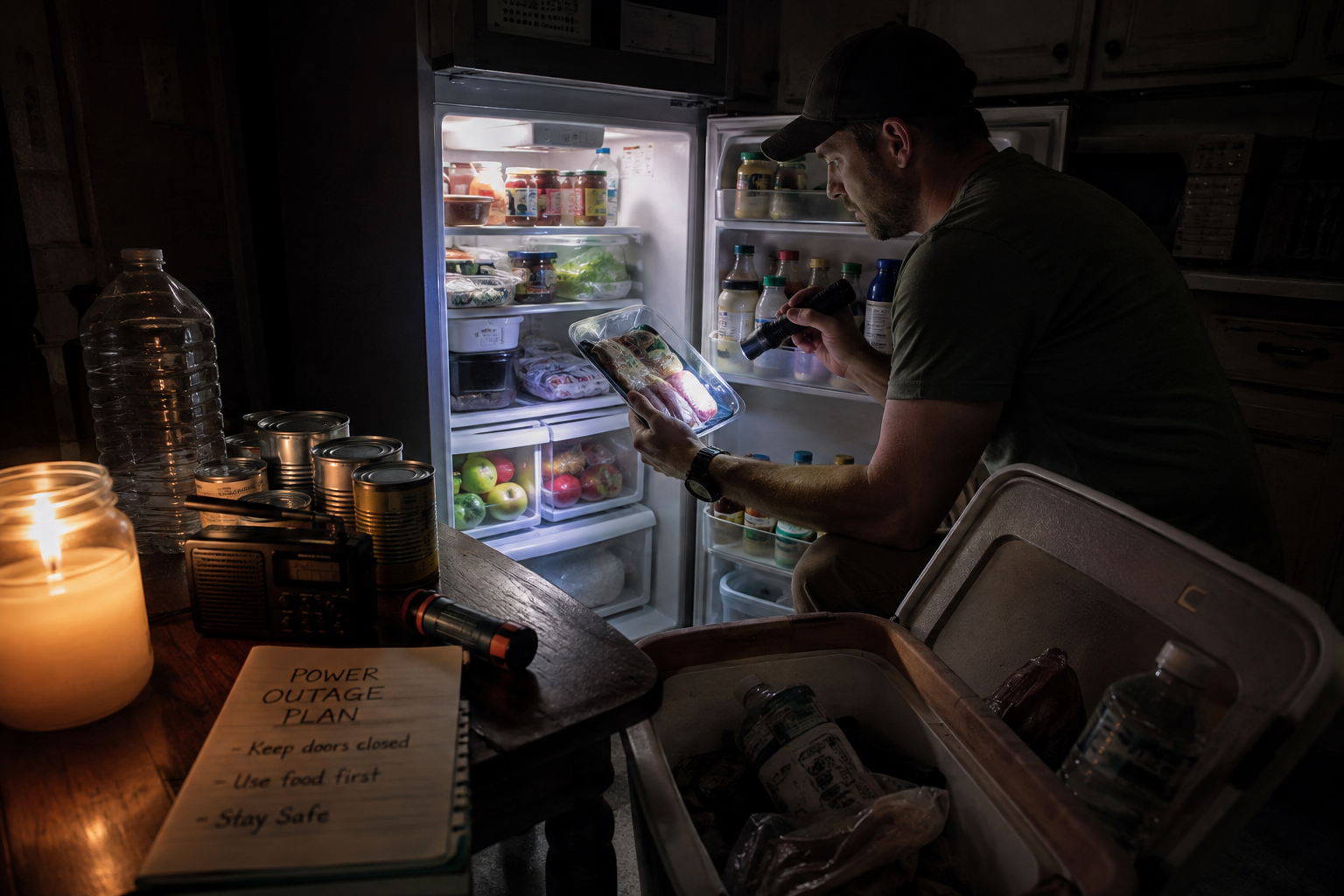
Your refrigerator has stopped.

And every minute that passes could be costing you food, money, and potentially creating a health hazard.
A refrigerator full of food can represent hundreds of dollars of supplies. During a prolonged outage, knowing how to manage those supplies can turn a frustrating inconvenience into an important survival advantage.
The key is understanding what to do before, during, and after the refrigerator loses power.
Don’t Open the Door
The first rule is simple:
Keep the refrigerator and freezer doors closed.
Every time you open the door, cold air escapes and warmer air enters.
That doesn’t mean you should panic if you accidentally open it. It means you should avoid repeatedly checking the temperature or looking for something to eat.
Think of the cold air inside your refrigerator and freezer as a stored resource.
Protect it.
If you have a refrigerator thermometer, you can monitor the temperature without relying on guesswork.
The Freezer Is Your Emergency Icebox
A full freezer has a major advantage during a power outage.
Frozen food and ice retain cold for much longer than an empty freezer.
If your freezer is only partially full, containers of frozen water can provide additional thermal mass.
This can also give you another useful resource: ice.
During normal times, consider freezing several containers of water.
Don’t completely fill rigid containers because water expands as it freezes.
Store them in the freezer so that if the power fails, you already have additional cold storage available.
Don’t Turn the Refrigerator Into a Cooler
A common mistake is transferring everything from the refrigerator into an outdoor cooler immediately.
That may actually make your situation worse if you have limited ice.
Instead, first determine what actually needs to be protected.
Keep the refrigerator closed.
Use a cooler strategically for items that need immediate attention when necessary.
If you have access to a reliable source of ice, you can prioritize the most valuable perishable foods.
The goal isn’t simply to make everything cold.
The goal is to preserve as much food as safely possible while using your limited cooling resources intelligently.
Eat Strategically
A power outage can change the order in which you should consume food.
Shelf-stable foods don’t need to be eaten first.
Fresh perishable foods generally deserve more attention.
Think about your refrigerator like a countdown.
Instead of randomly opening it several times a day, make a plan.
Use foods that require refrigeration when appropriate, while leaving shelf-stable supplies untouched.
This is where a properly stocked pantry becomes extremely valuable.
If your household has canned goods, rice, pasta, peanut butter, crackers, dehydrated foods, and other shelf-stable products, you don’t need to repeatedly open the refrigerator simply because the power is off.
Know What You Can Safely Keep
One of the most dangerous mistakes during an outage is relying on smell or appearance to determine whether food is safe.
Food can become unsafe without looking obviously spoiled.
Don’t taste questionable food to see whether it’s still good.
When you’re uncertain about a perishable item, the safest approach is to follow established food-safety guidance rather than gambling with your health.
A food thermometer and refrigerator thermometer can help you make better decisions.
And remember:
When in doubt, throw it out.
The money lost on questionable food is far less important than the consequences of foodborne illness during an emergency.
Don’t Forget the Freezer
People often concentrate on the refrigerator while ignoring the freezer.
That’s a mistake.
A freezer full of meat, vegetables, prepared meals, and other food could represent a significant portion of your household’s emergency food supply.
Keep it closed.
Don’t repeatedly dig through it.
If possible, group frozen foods together so they retain cold more efficiently.
A well-organized freezer is easier to manage during an outage than one packed randomly.
The Refrigerator Can Become a Water Problem
There is another issue people often overlook.
When the power comes back, you may immediately assume everything is fine.
But refrigerators and freezers can develop leaks, condensation, or melting ice.
Water can damage floors, cabinets, and stored items.
During a long outage, periodically inspect the area around the appliances without unnecessarily opening the doors.
If melting becomes significant, protect nearby flooring and move vulnerable items away from water.
Generator Safety Matters
A generator can keep your refrigerator operating during an extended outage.
But this is where survival preparation becomes a serious safety issue.
Never operate a fuel-burning generator inside your home, garage, basement, or another enclosed or poorly ventilated area.
Carbon monoxide is invisible and potentially deadly.
Generators must be operated outdoors and positioned according to the manufacturer’s safety instructions, away from doors, windows, and vents.
Don’t create a second emergency while trying to solve the first one.
Consider a Backup Power System
You don’t necessarily need a massive whole-house generator.
A properly sized portable power station, battery backup, or generator may be enough to keep essential appliances operating, depending on their electrical requirements.
Before purchasing anything, determine how much power your refrigerator actually consumes.
Look at the appliance’s specifications and consider startup requirements.
A refrigerator compressor can require significantly more power when starting than it uses during normal operation.
This is why simply buying a battery or generator based on its advertised wattage can lead to disappointment.
Know your numbers before the emergency.
Prepare Before the Power Goes Out
The best refrigerator survival plan starts while everything is working normally.
Keep your freezer reasonably full.
Store some frozen water containers.
Have a refrigerator thermometer.
Keep coolers accessible.
Maintain shelf-stable emergency food.
Have a plan for backup power if extended outages are common in your area.
And most importantly, know how your household will eat if the refrigerator becomes unavailable.
You don’t want to invent your emergency food plan while the kitchen is already getting warm.
The Bigger Lesson
A refrigerator doesn’t look like survival equipment.
It’s a normal household appliance.
But inside that appliance could be days or weeks of valuable food.
That makes your kitchen part of your emergency preparedness system.
The same principle applies throughout your home.
Your freezer is a storage system.
Your pantry is an emergency food reserve.
Your water heater may contain a substantial amount of water.
Your tools can become repair equipment.
Your vehicle can become transportation and a backup power source.
Survival preparation isn’t always about buying more gear.
Sometimes it’s about understanding the resources you already have.
The next time you open your refrigerator, take a look inside and ask yourself:
“If the power disappeared right now, how long could I preserve what is in here?”
That answer might tell you more about your preparedness than you expect.
Because when the lights go out, survival doesn’t begin in the woods.
Sometimes…
it begins in your kitchen.