When people imagine survival, they often picture the dramatic moments: building a fire in the wilderness, finding food, escaping a storm, or navigating through unknown terrain. While those skills matter, the most important survival tool is something you carry with you everywhere.
Your mindset.
In almost every emergency, the first battle is not against the environment. It is against fear, confusion, and panic.
A person with the right mindset and basic skills can overcome situations that would overwhelm someone who has the best gear in the world but does not know how to think clearly.

Survival starts in your head.
The First Few Minutes Matter Most
When something unexpected happens, your brain naturally reacts with stress. Your heart rate increases, your breathing changes, and your body prepares to react.
This response can help you move quickly, but it can also cause poor decisions.
People make survival mistakes when they:
- Run without knowing where they are going
- Ignore injuries because they are focused on escape
- Waste valuable supplies
- Panic instead of making a plan
- Assume someone else will solve the problem
The first survival skill is learning to stop, observe, and think.
A calm person has an advantage because they can see options that panic hides.
The S.T.O.P. Method
Survival experts often teach a simple method for handling emergencies:
S — Stop
Do not immediately react.
Take a moment to control your breathing and prevent a bad decision.
Ask yourself:
- Am I injured?
- Am I safe right now?
- What is the biggest danger?
T — Think
Analyze the situation.
Look around you.
What resources are available?
- Water sources
- Shelter opportunities
- Tools
- Natural materials
- Possible rescue signals
Survival is often about using what you have instead of wishing you had something else.
O — Observe
Pay attention to details.
Look for:
- Weather changes
- Signs of other people
- Animal activity
- Terrain features
- Direction of travel
Small details can make a huge difference.
A broken branch, a trail marker, smoke in the distance, or changing clouds can provide important information.
P — Plan
Before you act, create a simple plan.
A good survival plan answers:
- What is my biggest immediate threat?
- What action gives me the best chance of safety?
- What resources do I have?
- What is my next step?
A simple plan is better than a rushed decision.
Why Gear Does Not Replace Skill
Many people believe survival is about having the biggest backpack or the most expensive equipment.
Gear helps.
But gear can fail.
Batteries die.
Equipment breaks.
Supplies run out.
Skills stay with you.
Someone who understands how to build shelter, find water, start a fire, navigate, and solve problems has abilities that cannot be lost.
A survival knife is useful.
Knowing how to use it is more important.
A water filter is valuable.
Knowing where to find water is even more important.
A map is helpful.
Knowing how to read terrain gives you confidence.
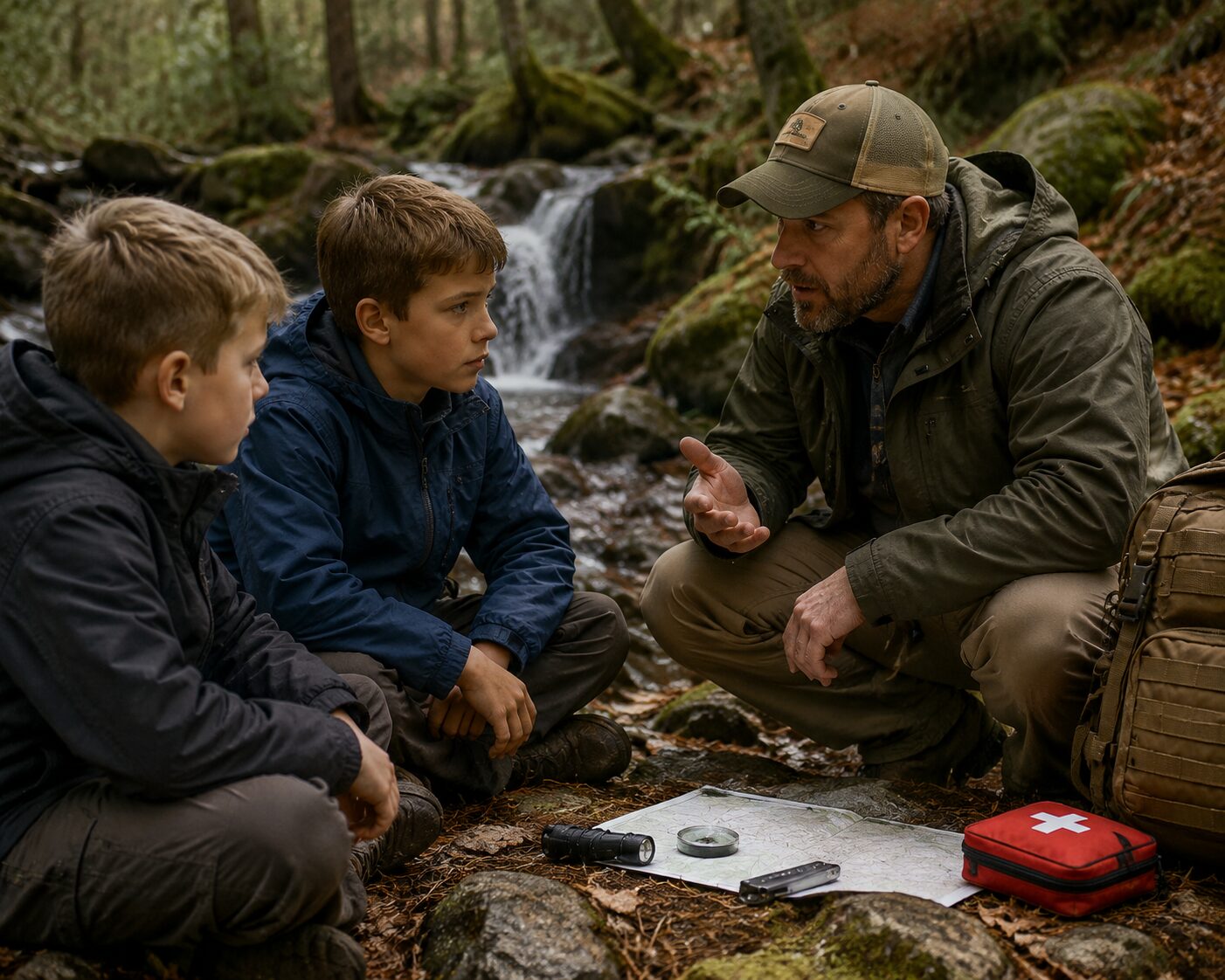
Teaching Kids the Survival Mindset
Survival skills are not only for adults.
Children who learn problem-solving skills become more confident and prepared.
Start with simple lessons:
Teach awareness
Ask questions like:
- What would you do if the power went out?
- How would you find your way home?
- What items would you take if you had five minutes to leave?
Make survival a game instead of something scary.
Teach responsibility
Kids can learn:
- How to pack a small emergency kit
- How to identify safe drinking water
- How to prepare simple meals
- How to use basic tools safely
- How to recognize danger
The goal is not to make children afraid.
The goal is to make them capable.
The 10-Minute Survival Challenge
Try this simple exercise:
Take ten minutes and imagine your home suddenly loses power.
No lights.
No internet.
No television.
No working appliances.
Ask yourself:
- Where are the flashlights?
- How much water do we have?
- How would we cook?
- How would we stay warm or cool?
- What would we do if the power stayed off for three days?
You will quickly discover what needs improvement.
Preparedness begins with awareness.
The Survival Advantage: Confidence
The strongest survival tool is confidence built through preparation.
Confidence does not mean believing nothing bad will happen.
It means knowing you can handle challenges when they do.
A prepared person does not panic because they have practiced.
They have thought through problems.
They have learned skills.
They know that even difficult situations can be broken down into smaller steps.
Final Thoughts
Survival is not about being the toughest person in the room.
It is about being the person who can stay calm, think clearly, and make good decisions when others cannot.
The wilderness, a natural disaster, or an emergency does not care how strong you are.
It rewards preparation.
Start learning today.
Learn one skill.
Practice one skill.
Teach one skill.
Because when everything goes wrong, the person who is prepared has the greatest advantage.
Stay ready. Stay skilled. Stay prepared.