By Survival Boys Editorial Team
Modern civilization runs on electricity.
Nearly every system people depend on daily—communication, banking, transportation, refrigeration, water treatment, fuel distribution, hospitals, and supply chains—relies on electronic infrastructure functioning continuously in the background. Most people rarely think about how interconnected those systems are until a power outage interrupts normal life for a few hours.
Now imagine a blackout that lasts not hours, but weeks or even months.

That possibility is why EMP preparedness has become one of the most discussed topics in survival and preparedness communities.
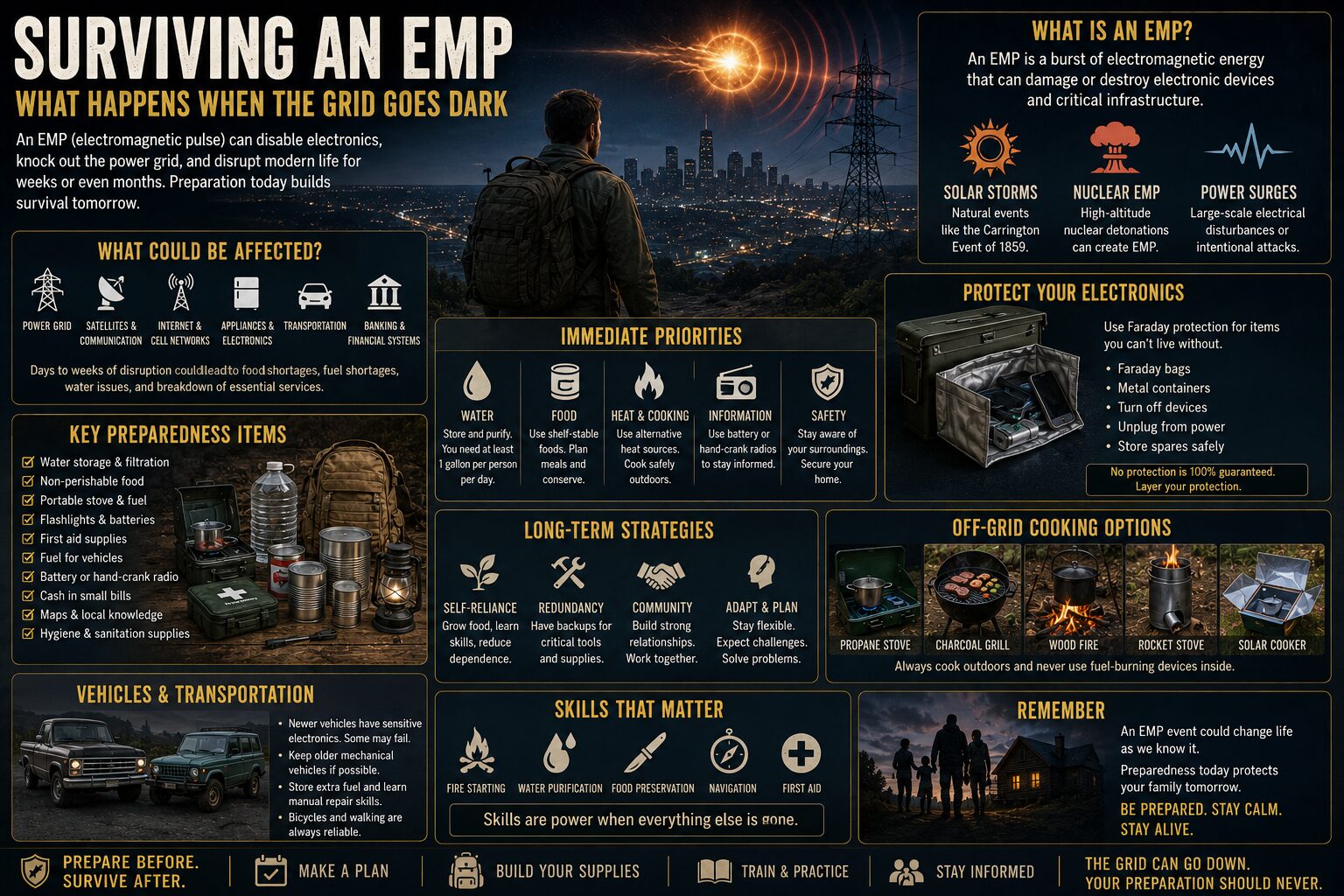
An EMP, or electromagnetic pulse, is a burst of electromagnetic energy capable of damaging or disabling electronic systems. EMPs can originate from several sources, including solar storms, specialized weapons, or certain large-scale electrical disturbances. While Hollywood often dramatizes EMP events, the underlying concern is real: modern society is heavily dependent on vulnerable electrical infrastructure.
The most famous historical example connected to EMP concerns is the Carrington Event of 1859. A massive solar storm struck Earth, disrupting telegraph systems around the world. Operators received electrical shocks, equipment sparked unexpectedly, and some systems continued functioning even after being disconnected from power sources.
At the time, society depended very little on electricity compared to today.
A similar event occurring now could affect satellites, communication systems, transformers, transportation networks, internet infrastructure, and portions of the electrical grid on a massive scale.
One of the most important things to understand about EMP survival is that the event itself is often not the greatest danger.
The real threat comes from the collapse of systems people depend on afterward.
Most households rely on grocery stores that receive constant deliveries. Fuel stations depend on electric pumps. Water treatment plants require power. Hospitals use electronic systems for nearly everything. Supply chains operate through computerized logistics networks moving continuously across the country.
If large portions of that infrastructure stopped functioning simultaneously, everyday life would change extremely fast.
Food shortages would likely develop quickly in heavily populated areas. Communication networks could become unreliable. Fuel access might disappear. Refrigeration failures would spoil large amounts of food within days. ATMs and electronic payment systems might stop working entirely.
Preparedness for an EMP event focuses less on the pulse itself and more on long-term self-reliance afterward.
Water becomes one of the highest priorities immediately after any major grid failure. Municipal water systems depend heavily on electrically powered pumps and treatment facilities. Without power, water pressure may disappear quickly in many areas.
Preparedness-minded families often store emergency water supplies ahead of time while also maintaining backup purification methods. Water filters, rainwater collection systems, wells, and purification tablets all become valuable during prolonged outages.
Food storage becomes equally important. Modern grocery stores operate using just-in-time delivery systems with very limited backup inventory. During emergencies, shelves empty quickly, even during short-term disasters like hurricanes or snowstorms.
Long-term emergencies require shelf-stable foods capable of being stored safely without refrigeration. Rice, beans, canned goods, dehydrated foods, oats, pasta, and freeze-dried meals are common preparedness staples because they store well and provide reliable calories.
Cooking also becomes a challenge during extended outages. Electric stoves, microwaves, and many modern appliances stop functioning completely without power. Off-grid cooking systems such as propane stoves, charcoal grills, wood fires, rocket stoves, and solar cookers become extremely valuable.
Communication may become difficult after a large EMP event, depending on the scale of infrastructure damage. Cell towers, internet systems, and radio networks all depend on powered infrastructure. Battery-powered emergency radios allow families to monitor information if broadcasting systems remain active.
Some preparedness enthusiasts store backup electronics inside Faraday containers designed to reduce electromagnetic exposure. Metal containers, specialized Faraday bags, and shielded storage systems may help protect certain small electronics from electrical surges, depending on the event type and intensity.
However, no preparedness system guarantees perfect protection.
The focus should always remain on resilience rather than fantasy scenarios.
Transportation would likely become another major issue. Modern vehicles contain extensive electronic systems controlling ignition, fuel injection, navigation, and safety features. Depending on the severity of the EMP, some vehicles could become disabled while others might continue functioning.
Fuel distribution itself would become a larger problem regardless of vehicle survivability because refineries, pipelines, and gas stations all rely heavily on electricity and computerized systems.
Preparedness-minded people often emphasize mobility alternatives such as bicycles, walking, or older mechanical equipment that is that is less dependent on complex electronics.
Medical preparedness becomes critically important as well. Hospitals rely on backup generators, but fuel supplies and replacement parts remain limited during prolonged infrastructure failures. Prescription medications, refrigeration-dependent medicines, and advanced medical equipment could all become difficult to maintain.
Basic first aid knowledge, stocked medical supplies, and preventative health practices become far more valuable when professional care becomes harder to access.
One of the most overlooked aspects of EMP survival is sanitation.
Without running water, waste management systems quickly deteriorate. Toilets stop functioning properly if water systems fail, garbage accumulates, and disease risks increase rapidly in densely populated areas. Simple sanitation planning can dramatically improve health outcomes during long-term emergencies.
Mental resilience also matters enormously during grid-down situations.
Modern society depends heavily on routine, communication, entertainment, and convenience. Extended blackouts create stress, uncertainty, boredom, and fear very quickly. Families who remain calm, organized, and adaptable usually handle emergencies far more effectively than those who panic.
Morale becomes a survival tool.
Simple routines, shared responsibilities, warm meals, and communication within families all help maintain emotional stability during difficult situations.
Community relationships also become extremely important during prolonged emergencies. Neighbors who cooperate, share information, and assist one another often recover far more effectively than isolated individuals trying to handle everything alone.
Preparedness is strongest when communities develop resilience together.
Security concerns may also increase during large-scale infrastructure failures. Darkness, shortages, communication breakdowns, and panic can create opportunities for theft or violence in some situations. Household security, awareness, and avoiding unnecessary attention become increasingly important during unstable conditions.
However, survival is rarely about dramatic action movie scenarios.
Most real emergencies involve problem-solving, patience, resource management, and maintaining stability under stress.
One major misconception about EMP events is that survival depends entirely on expensive gear. While supplies matter, knowledge and planning matter far more. Families who understand water purification, food storage, cooking, first aid, sanitation, and communication possess enormous advantages regardless of equipment.
Preparedness is not about fear of catastrophe.
It is about reducing vulnerability.
Power outages already happen regularly due to storms, hurricanes, cyberattacks, wildfires, and infrastructure failures. EMP preparedness overlaps heavily with general emergency readiness because many of the same principles apply: store water, maintain backup food, secure alternative cooking methods, prepare lighting, protect communication systems, and build self-reliance skills.
The modern world depends on electricity more than at any other point in history.
That dependence creates both convenience and vulnerability.
An EMP event, whether caused by nature or human activity, would remind society very quickly how fragile complex systems can become when power disappears.
But preparedness changes the equation.
Because when systems fail, the people most likely to endure are not necessarily the strongest or wealthiest.
They are the ones who prepared before the lights went out.